
Saddened by the passing of Justice Ruth Bader Ginsburg, who gave us advisory federal sentencing guidelines
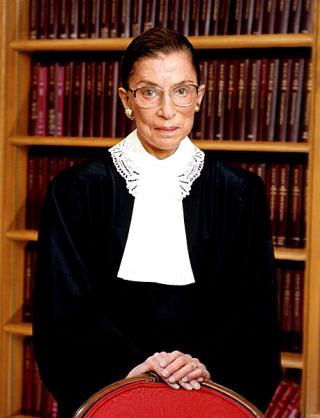
Supreme Court Justice Ruth Bader Ginsburg, a diminutive yet towering women’s rights champion who became the court’s second female justice, died Friday at her home in Washington. She was 87. Ginsburg died of complications from metastatic pancreatic cancer, the court said….
Chief Justice John Roberts mourned Ginsburg’s passing. “Our Nation has lost a jurist of historic stature. We at the Supreme Court have lost a cherished colleague. Today we mourn, but with confidence that future generations will remember Ruth Bader Ginsburg as we knew her — a tireless and resolute champion of justice,” Roberts said in a statement….
Her appointment by President Bill Clinton in 1993 was the first by a Democrat in 26 years. She initially found a comfortable ideological home somewhere left of center on a conservative court dominated by Republican appointees. Her liberal voice grew stronger the longer she served….
On the court, where she was known as a facile writer, her most significant majority opinions were the 1996 ruling that ordered the Virginia Military Institute to accept women or give up its state funding, and the 2015 decision that upheld independent commissions some states use to draw congressional districts.
Besides civil rights, Ginsburg took an interest in capital punishment, voting repeatedly to limit its use. During her tenure, the court declared it unconstitutional for states to execute the intellectually disabled and killers younger than 18. In addition, she questioned the quality of lawyers for poor accused murderers….
Ginsburg authored powerful dissents of her own in cases involving abortion, voting rights and pay discrimination against women. She said some were aimed at swaying the opinions of her fellow judges while others were “an appeal to the intelligence of another day” in the hopes that they would provide guidance to future courts. “Hope springs eternal,” she said in 2007, “and when I am writing a dissent, I’m always hoping for that fifth or sixth vote — even though I’m disappointed more often than not.”
She wrote memorably in 2013 that the court’s decision to cut out a key part of the federal law that had ensured the voting rights of Black people, Hispanics and other minorities was “like throwing away your umbrella in a rainstorm because you are not getting wet.”
When I think about Justice Ginsburg’s sentencing legacy, I do not think about any single opinion but rather about two notable votes. Specifically, Justice Ginsburg was the sole justice to vote with both remarkable majority opinions in US v. Booker: she was the key fifth vote for the merits opinion finding the mandatory federal guidelines unconstitutional and she was the key fifth vote for the remedial opinion making the guidelines advisory. Notably, Justice Ginsburg did not write any opinion in Booker to explain either vote, but her two votes gave us the advisory guideline system that has now defined the federal sentencing system for well over fifteen years.