
Prison Policy Initiative reports on “States of Incarceration: The Global Context 2018” and “States of Women’s Incarceration: The Global Context 2018”
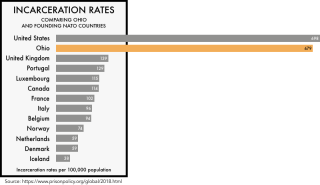
Oklahoma now has the highest incarceration rate in the U.S., unseating Louisiana from its long-held position as “the world’s prison capital.” By comparison, states like New York and Massachusetts appear progressive, but even these states lock people up at higher rates than nearly every other country on earth . Compared to the rest of the world, every U.S. state relies too heavily on prisons and jails to respond to crime….
If we imagine every state as an independent nation, … every state appears extreme. 23 states would have the highest incarceration rate in the world — higher even than the United States. Massachusetts, the state with the lowest incarceration rate in the nation, would rank 9th in the world, just below Brazil and followed closely by countries like Belarus, Turkey, Iran, and South Africa.
In fact, many of the countries that rank alongside the least punitive U.S. states, such as Turkmenistan, Thailand, Rwanda, and Russia, have authoritarian governments or have recently experienced large-scale internal armed conflicts. Others struggle with violent crime on a scale far beyond that in the U.S.: El Salvador, Russia, Panama, Costa Rica, and Brazil all have murder rates more than double that of the U.S. Yet the U.S., “land of the free,” tops them all….
For four decades, the U.S. has been engaged in a globally unprecedented experiment to make every part of its criminal justice system more expansive and more punitive. As a result, incarceration has become the nation’s default response to crime, with, for example, 70 percent of convictions resulting in confinement — far more than other developed nations with comparable crime rates.
Today, there is finally serious talk of change, but little action that would bring the United States to an incarceration rate on par with other stable democracies. The incremental changes made in recent years aren’t enough to counteract the bad policy choices built up in every state over decades. For that, all states will have to aim higher, striving to be not just better than the worst U.S. states, but among the most fair and just in the world.