
Looking at latest notable Texas death penalty realities
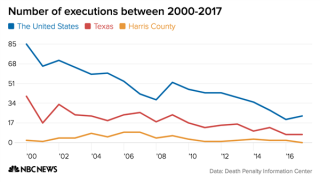
Since the Supreme Court legalized capital punishment in 1976, Harris County, Texas, has executed 126 people. That’s more executions than every individual state in the union, barring Texas itself. Harris County’s executions account for 23 percent of the 545 people Texas has executed. On the national level, the state alone is responsible for more than a third of the 1,465 people put to death in the United States since 1976.
In 2017, however, the county known as the “death penalty capital of the world” and the “buckle of the American death belt” executed and sentenced to death an astonishing number of people: zero. This is the first time since 1985 that Harris County did not execute any of its death row inmates, and the third year in a row it did not sentence anyone to capital punishment either.
The remarkable statistic reflects a shift the nation is seeing as a whole. The number of executions has been trending downward across the United States, but it’s particularly noticeable in Texas and Harris County.
“The practices that the Harris County District Attorney’s Office is following are also significant because they reflect the growing movement in the United States toward reform prosecutors who have pledged to use the death penalty more sparingly if at all,” said Robert Dunham, the director of the Death Penalty Information Center.
The city of Houston lies within the confines of Harris County, making it one of the most populous counties in the country — and recently it became one of the most diverse, with a 2012 Rice University report concluded that Houston has become the most diverse city in the country. Under these new conditions, Kim Ogg ran in 2016 to become the county’s district attorney as a reformist candidate who pledged to use the death penalty in a more judicious manner than her predecessors, though the longtime prosecutor didn’t say she would abandon it altogether. Rather, Ogg said she would save it for the “worst of the worst” — such as serial killer Anthony Shore, who was rescheduled for execution next month.
But this year, Ogg appears to have held true to her promise of only pursuing the death penalty in what she deems the most extreme cases. It represents a break from a long pattern of Harris County prosecutors who pushed for the death penalty in nearly all capital cases. “The overall idea of what makes us safer is changing,” Ogg said. “We’re reframing the issues. It’s no longer the number of convictions or scalps on the wall. It’s making sure the punishment meets the crime….”
But Ogg said she cannot alone take credit for the recent drop in executions. The trend precedes her slightly and can also be connected to better educated and more diverse jury pools, as well as Texas’ new sentencing option of life without parole. The state also has a more skilled group of indigent defense lawyers who build up mitigating circumstances — such as an abusive childhood or mental illness — for an alleged murderer’s crime.
Even a state like Texas might stop sentencing alleged killers to death in the near future. And that trend could well extend nationwide. “We’ve seen a deepening decline in the death penalty since the year 2000, and some states fell faster than others,” said University of Virginia law professor Brandon Garrett, who wrote “End of Its Rope: How Killing the Death Penalty Can Revive Criminal Justice.” He added that the declines are steepest in counties that had sentenced the most people to death.