
“Murder Is Up Again In 2017, But Not As Much As Last Year”
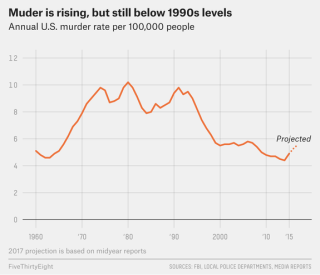
Big U.S. cities1 saw another increase in murders in the first half of 2017, likely putting them on track for a third straight year of rising totals after murder rates reached historic lows in 2014. So far, however, this year’s increase is considerably smaller than it was in each of the past two years; the big-city numbers are consistent with only a modest rise in murders nationwide. Overall, if recent numbers hold, the nation’s murder rate will likely rise but remain low relative to where it was from the late 1960s through the 1990s.
The FBI collects national data on murders and other major crimes, but it releases them after a significant lag. The most recent full year for which official data is available is 2015, when murders rose at their fastest pace in a quarter century. Official 2016 data won’t be available until the fall, but murder almost certainly rose last year too; in January, I found that big cities experienced a roughly 11 percent increase in murders in 2016, which past patterns suggest is consistent with about an 8 percent rise in murder overall.
In order to gauge changes in the prevalence of murder in big cities in 2017, I collected year-to-date murder counts for 2017 and 2016 in 68 of the country’s big cities, using a mixture of data from the cities themselves and from media reports. Data from 63 of the cities included murders committed through at least the end of May, and 50 cities provided data covering the month of June. These big cities have had roughly 4 percent more murders so far in 2017 than they did at the same point in 2016.
Only a handful of cities are seeing large increases or decreases in murder this year, which is what we would expect to see given a small overall rise in the sample….
Big cities tend to exaggerate national murder trends, both up and down — so a large rise in big-city murder usually corresponds with a slightly smaller national increase. If murder rose roughly 8 percent nationally in 2016 (as my January estimate suggests) and is set to rise a few percentage points in 2017, then the nation’s murder rate in 2017 will be roughly the same as it was in 2008. That’s still more than 40 percent lower than the country’s murder rate in the early 1990s (but roughly 27 percent higher than it was in 2014).
Ultimately, this year’s trend is similar to last year’s in that more big cities are seeing a rise in the number of murders than are seeing a decline. There are still six months left in 2017, and while anything could happen, the most likely outcome is that — although this year’s rise will likely be smaller than last year’s — the country will see murders increase for a third straight year.
As regular readers know, Attorney General Sessions has made much of rising crime rates in his criticisms of Obama era criminal justice reforms and in his defense of his recent decision to toughen federal prosecutorial charging and sentencing practices. This kind of data showing still further (though smaller) increases in murders in 2017 on the heels of significant increases in 2015 and 2016 will likely only reinforce the views of AG Sessions and others in the Trump Administration that “tough and tougher” federal sentencing policies and practices are needed to enhance public safety.