
Is there any good reason for Governor Jerry Brown NOT to grant clemency to Shirley Ree Smith?
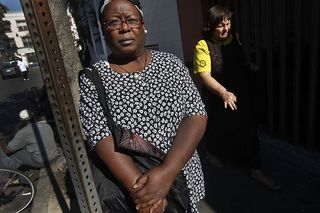
Gov. Jerry Brown is giving strong consideration to a clemency petition for a grandmother whose conviction for shaking her infant grandson to death was overturned by an appeals court and reinstated by the U.S. Supreme Court, lawyers close to the case said.
The governor, who received the petition Wednesday, is being asked to commute the life sentence of Shirley Ree Smith, a 51-year-old grandmother who was sentenced to 15 years to life in 1997 for causing the death of a child.
Although Brown is notoriously unpredictable, a longtime advisor said he would be “very surprised” if Brown did not grant clemency to Smith, who has spent 10 years in prison for a death she has maintained was a tragic case of Sudden Infant Death Syndrome, not a crime against a beloved child.
A federal appeals court found “no demonstrable support” for the prosecution’s claim that Smith shook 7-week-old Etzel Glass to death in 1996 and granted her release from prison in 2006 after striking her conviction by a Van Nuys jury. But the U.S. Supreme Court in October reinstated the conviction on the grounds that courts should not second-guess verdicts “supported by the record.”
The high court admitted that doubts about Smith’s guilt were “understandable,” and three justices penned a dissent criticizing the majority in the 6-3 decision for intervening to assert a procedural point.
A growing number of medical experts have questioned the science behind so-called “shaken baby” cases, especially those decided in decades past. Smith’s trial took place only weeks after the headline-grabbing case of British nanny Louise Woodward brought the fatal act of child abuse to the nation’s attention.
Clemency petitions are generally futile, granted mostly when governors are leaving office. But Smith’s case so concerned some federal judges that they privately reached out to ensure that the petition got Brown’s close attention, lawyers said.
Three weeks ago, a clerk from the 9th Circuit called Michael Brennan, Smith’s attorney, asking if he was going to file a clemency petition. Brennan said he told her he would but considered it futile. “All the clerk said was, ‘You might be mistaken. A petition might be well received,’ ” Brennan said. “Clearly, she was sort of saying, ‘File the petition.’ “
Smith, reached at her home in Kankakee, Ill, said she has been living on tenterhooks waiting for word on whether she must go back to prison to serve the remainder of her sentence. “I’ve been trying to find someone who can explain to me what’s going on,” said Smith, who was hoping to follow her daughter to Minnesota so she could continue babysitting her younger grandchildren. “The lawyers keep saying this isn’t about me, it’s about the courts and the law on decisions. But how can it not be about me when I’m the one who may have to go back to prison?”
In the fall of 1996, Smith moved to Van Nuys from Illinois to help her daughter Tomeka care for newborn Etzel, 14-month-old Yondale and 3-year-old Yolanda. On the night of Etzel’s death, Smith was sleeping in the living room of her sister’s apartment with the three grandchildren. When she got up to use the bathroom, she found him lifeless and summoned paramedics. An emergency room physician listed the cause of death as SIDS.
An autopsy revealed a small pool of blood on the baby’s brain, which two officials in the medical examiner’s office testified at Smith’s trial was the result of violent shaking. Neither defense expert testimony that the baby probably died of SIDS nor Tomeka’s assertions that her mother had never raised a hand against her or her children dissuaded jurors from the prosecution’s theory that Smith had become irritated by the infant’s crying and shook him to make him stop.
Given that the majority opinion in the Supreme Court ruling that reinstated Sirley Ree Smith’s conviction make express reference to the clemency process (noted here), I find it disturbing — and perhaps a telling indication of the sorry state of modern clemency politics and practice — that her lawyer considered a clemency petition to be likely futile. Moreover, as the title of this post suggests, I have a hard time coming up with a reason why Governor Brown should not commute Smith’s sentence to time served.
Smith claims she is innocent, and there seems little dispute that the evidence she committed any crime is less than lock solid. If she is indeed innocent (and Governor Brown is convinced of this fact), a mere sentence commutation is really an insufficient clemency response, but still justified and justifiable. And, based on what I have read, it does not seem that the prosecution ever claimed Smith meant to kill her grandchild. Thus, even if she was involved in the child’s death, the decade Smith has spent in prison surely strikes me as more than enough prison time to punish someone for accidentally causing an infact’s death. Finally, California surely cannot afford “wasting” scarce prison monies and space on a person who would seem to pose no threat to the public and whose own daughter apparently still wants her involved in the care of her grandchildren.
I suppose one could urge resisting the arguments for clemency here by taking the view that a Governor should never grant clemency for any reason in any case. (My understanding is that Mitt Romney has express such a view in the past.) But unless you are absolutely against the exercise of clemency in every case, I wonder if there is any reason not to support clemency in this case.