
“Who Benefits When A Private Prison Comes To Town?”
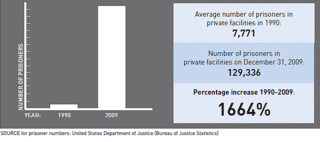
Federal and state officials are increasingly contracting private companies to run prisons and immigration detention centers. Critics have long questioned the quality of private prisons and the promises of economic benefits where they are built. But proponents say private prisons not only save taxpayers money, but they also generate income for the surrounding community.
In 2004, officials in Hardin, Mont., agreed to a deal for a private prison to be built in town. The idea was that the county would pay for the prison and the state or federal government would fill it. Hardin would get tax revenues, new jobs and economic benefits while a private prison company would run the place and get a cut of the profits.
The Two Rivers Regional Detention Facility, a 464-bed $27 million private prison, was completed in 2007. Since then, the facility has remained empty and unused because the builder never landed a contract with the state or federal government for inmates. In 2009, the facility made national news when, in an attempt to recoup the money it had spent on the facility, the town offered to do something almost no other town in America was willing to do — house prisoners from Guantanamo Bay.
That didn’t happen, but it’s a testament to how desperate Hardin is to fill the prison, get it up and running, and create jobs for the town….
Despite the criticism private prisons face, as an industry they do very well. They make money, a little for some of the towns where they’re built and a lot for shareholders and investors.
“This is an investment that we talk with investors about on a regular basis as a good idea,” investment analyst Tobey Sommer tells Sullivan. Sommer, director of equity research at SunTrust Robinson Humphrey in Tennessee, says both CCA and Geo Group made more than $1 billion each last year and their CEOs took home multimillion-dollar bonuses.
The recession could actually make them more money, Sommer says. With budgets stretched thin, states might look to private prisons to house and secure even more inmates. Only 10 percent of all inmates in the U.S. are housed in private prisons, he says, so that other 90 percent could be seen as an opportunity for growth.
But not everyone sees opportunities for long-term growth. “Crime rates are declining, the prison population is declining, and many states, in large part motivated by the economic downturn, are realizing that they can’t keep building their way out of the problem,” says Michele Deitch, who teaches criminal justice at the Lyndon B. Johnson School of Public Affairs at the University of Texas.
Deitch says the new growth market for prison companies is immigrant detention, like the facility in Karnes County. New prisons, possibly for state inmates, like the one in Hardin, Mont., are on the decline.