
“Federal Folly: FY2012 U.S. Department of Justice budget gorges on prisons, gouges juvenile justice”
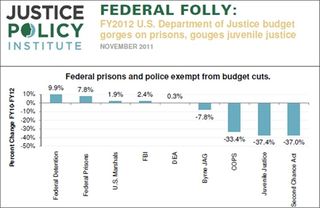
Last week Congress passed a 2012 budget for the U.S. Department of Justice that puts locking people up ahead of helping reduce delinquency, protecting youth that do come into contact with the juvenile justice system, and improving outcomes for the formerly incarcerated. This brief is intended to show the potential impacts of these funding schemes and what can be done instead to improve communities.
Juvenile Justice Programs received $546.9 million in FY2002. Funding has been dropping almost consistently since then, and with the proposed FY2012 budget, down to $263 million…
Both the FBI and the Drug Enforcement Administration (DEA) are budgeted to receive increases in funding, despite decreases in crime. With crime rates falling, both agencies should have been targeted for budget cuts. In particular, as public opposition to the “War on Drugs” is growing, the federal government should re-examine the negative impacts of continuing to pursue a law enforcement approach to drug addiction, when a public health approach has been shown to be much more successful.
Similar to efforts at the state and local level, increasing federal law enforcement will likely result in more people arrested for lower level drug and other offenses and increased prison populations.
There are currently more than 2.4 million people incarcerated in U.S. prisons and jails, the highest per capita rate in the world. Attempting to improve public safety through increased law enforcement and correctional spending is a failed approach. If the Administration and Congress want to spend scarce federal dollars to improve public policies that have been shown to have positive and long-lasting effects on individuals and communities. These programs include:
- community-based substance abuse and mental health treatment;
- evidence-based prevention programs for youth;
- employment, job skills, and education resources for underserved communities; and
- diversion programs that keep people from entering the corrections system.
Putting resources toward these positive opportunities is the most effective, and costeffective, way of increasing public safety.