
Detailed coverage of Michigan’s juve LWOP policies and practices
They were teenagers once, and did horrible things, or were in horrible places. People died. Sometimes at their hands; sometimes not. But they were present. And for that, they were told they will die, too, in prison.
These are Michigan’s “juvenile lifers,” although most are much older now, sentenced to life in prison without chance of parole. And there are more in this state than in almost any other.
There is Keith Maxey, wounded in a drug theft gone bad. He was unarmed and fled, but another man was killed. A jury found the 16-year-old just as responsible as if he had pulled the trigger. Except the shooter got a lighter sentence.
There, too, are identical twins David and Michael Samel, arrested at 17 for beating a pool hall worker to death. Michael pleaded to a reduced charge and was released in 2009. David took his chances with a jury. He is in the 30th year of life without parole.
And there is Cedric King, 14 when he helped set up a marijuana thief to be killed. Except the court thought he was a year older, and the victim survived. Still, confusion has persisted for years over whether he was given the state’s severest punishment, or something less, a Booth Michigan investigation found.
As a federal judge in Detroit weighs whether such sentences are unconstitutional, reporters from seven newspapers and MLive.com spread out across the state. They interviewed nearly two dozen inmates, including some who committed their crimes before they could drive. They also talked to victims’ families, prosecutors, judges and lawmakers. What they found was regret and bitterness, anger and forgiveness. They also found an issue measured more in shades of gray than black and white.
Ask Shirley Schwartz what her brother would think of imprisoning juveniles for life, and she pauses. “That’s a really difficult question,” she finally says. Her college professor brother was “very liberal,” she recalls, an advocate for his urban neighborhood in Grand Rapids’ Heritage Hill. That was where he met his killers; Jerry Freid died after being beaten to death with a baseball bat during a burglary by a 16- and a 17-year-old.
Ask Schwartz the same question, what she thinks of life sentences for juveniles, and she does not hesitate. “I never believed in the death penalty,” she says. “After this happened, I was pretty sure I could pull the switch. You can afford to be a liberal when it doesn’t touch you.” Told one of her brother’s killers died in prison, Schwartz says one word. “Good.”
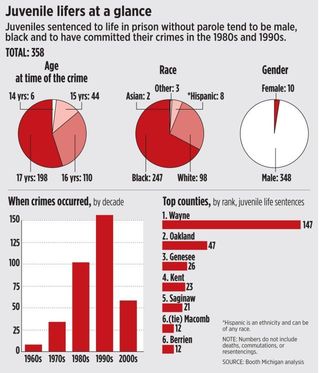
Michigan spends more than $10 million a year to house more juvenile lifers than all but one other state, Pennsylvania. In all, 358 inmates are serving life sentences for crimes committed from ages 14 to 17. One in five has been in prison 25 years or longer. The oldest is 67, now that two older lifers have died.
All this could change. A federal lawsuit pending in Detroit claims life without parole for juveniles 17 and younger constitutes cruel and unusual punishment. It seeks mandatory parole reviews when young inmates reach 21, then every five years after. The lawsuit has had early success. A judge in July threw out the claims of eight inmates imprisoned since their teens, ruling too much time had passed. But he allowed one inmate to move forward — Keith Maxey.
Deborah LaBelle, the lawsuit’s lead attorney, says she has met with about 100 of the inmates and corresponded with more than 300. She blames a “toxic combination” in Michigan of juvenile reforms, mandatory sentences and immature judgment she says puts minors at a disadvantage in adult courts.
I find the the stories of— and constitutional challenges to — juve LWOP in Michigan to be especially interesting and important because Michigan was the first US state to abolish the death penalty way back in the 1840s. It seems notable that the state’s historic disaffinity for the ultimate punishment of death did not prevented it from embracing its functional equivalent in modern times. Against this backdrop, one can also argue that the Supreme Court’s Eighth Amendment rulings in Roper and Graham ought to have even more bite in Michigan: if those rulings are understood dynamically to prohibit giving juvenile offenders the most severe sentences available to adult, then arguably juvenile should not be able to receive LWOP for any crime in any state that does not have capital punishment.