
Lamenting (yet again) extreme death penalty criticism and insufficient LWOP concerns
Sentencing people to death without taking account of aggravating and mitigating circumstances leads to arbitrary results. Yet … so does considering such circumstances because it requires jurors to weigh competing factors and makes sentencing vulnerable to their biases.
Those biases are driven by race, class and politics, which influence all aspects of American life. As a result, they have made discrimination and arbitrariness the hallmarks of the death penalty in this country….
The problems go on: Many defendants in capital cases are too poor to afford legal counsel. Many of the lawyers assigned to represent them are poorly equipped for the job….
Politics also permeates the death penalty, adding to chances of arbitrary administration. Most prosecutors in jurisdictions with the penalty are elected and control the decision to seek the punishment. Within the same state, differing politics from county to county have led to huge disparities in use of the penalty, when the crime rates and demographics were similar. This has been true in Pennsylvania, Georgia, Texas and many other states….
All but a few developed nations have abolished the death penalty. It is time Americans acknowledged that the death penalty cannot be made to comply with the Constitution and is in every way indefensible.
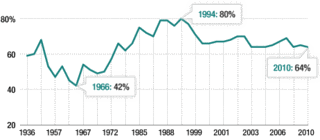
All of the problems highlighted by the NY Timesin this editorial apply at least as forcefully to the punishment of life without parole (LWOP) as to the punishment of death in the United States. Moreover, while the death penalty is mentioned in the Constitution and has long been part of America’s sentencing history, LWOP finds no support in either the Constitution’s text or history (or really in any other “developed nations” for that matter). Most important, as the chart above shows, strong public support for capital punishment readily supplies the key “defense” for the death penalty in America: our constitutional commitment to democracy — to “government of the people, by the people, for the people” — means that popular support for this ultimate punishment can (and will) keep it on the books.
Further, America’s sentencing laws each year subjects only a few dozen aggravated murderers in a few states to the real prospect of a death sentence and execution. And those aggravated murderers typically will face death as a punishment only if and when the victim’s family, and a set of prosecutors, and a set of jurors, and a set of judges all independently decide that death is a fair and fitting punishment. Asserting that “discrimination and arbitrariness [and] the hallmarks of the death penalty” fails to acknowledge that (1) only a small number of aggravated murderers are even eligible for a death sentence, and (2) lots of victims and prosecutors and juries spare most aggravated murderers from actually receiving a death sentence, and (3) lots of judges and executive officials spare the most of those sentenced to death from actually getting executed.
Meanwhile, America’s sentencing laws each year subject thousands of lesser offenders to LWOP or functional LWOP sentences (six years ago the US lifer count was over 130,000, but that included folks serving life with parole). And often it merely takes one charging decision by a lone prosecutor or one sentencing decision by a lone trial judge to forever extinguish the chance for many lesser offenders to ever have even a chance to regain their liberty before dying in prison. Further, there are strong reasons to fear that wrongful convictions, racial and economic and geographic biases, and ineffective lawyering are far bigger problems for the huge numbers facing LWOP than for the relatively tiny number facing death sentences. Moreover, while SCOTUS rulings have ensured that no juvenile or mentally retarded aggravated murderers are on death row, there are still thousands of juvenile offenders and probably even more mentally retarded offenders serving LWOP sentences throughout the United States (some of whom likely are wrongfully convicted and most of whom likely suffered from racial, economic and geographic biases and ineffective lawyering).
The Supreme Court’s important Graham ruling last year reveals that a majority of Supreme Court Justices are starting to appreciate that LWOP sentences are sometimes used for lesser crimes and for lesser offenders in a manner that really “cannot be made to comply with the Constitution and [are] in every way indefensible.” Moreover, I am always pleased to learn about savvy sentencing reformer working in Texas and elsewhere who appreciate that a lot of good can be done seeking to convince the public and legislators that lesser offenders at least get a chance in their old age to seek a last gasp of liberty.
But it seems that hard-core abolitionists (like the editors at the New York Times) — whose cause I respect, but whose tactics, fervor and extreme rhetoric always trouble me — are still slow to appreciate the potential value and critical importance of greater concern for the greater number of greater LWOP injustices than for what they alone perceive to be the death penalty’s unique (and uniquely democratic) immorality. So I expect there will be more posts here (yet again) complaining about how much advocacy energy and extreme rhetoric is expended simply trying to help get a few dozen aggravated murderers moved from the death row parts to the LWOP parts of our massive modern prisons. (A final irony here: most state death rows are safer, have better facilities, and are less crowded than most other part of modern state prisons.)
A few recent posts on the Davis case and older posts on capital obssesions:
- Executions number 1268 and 1269 of the modern US capital era go forward in Texas and Georgia
- Residual doubt, race, federalism and finality: which death penalty legal fronts might the Davis case impact?
- Lots and lots of notable death penalty headlines and commentary
- An insightful spin on reform and justice in the wake of the Davis case
- Why I obsess over courts and others obsessing about the death penalty