
“As Federal Crime List Grows, Threshold of Guilt Declines”
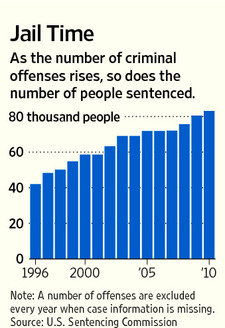
Back in 1790, the first federal criminal law passed by Congress listed fewer than 20 federal crimes. Today there are an estimated 4,500 crimes in federal statutes, plus thousands more embedded in federal regulations, many of which have been added to the penal code since the 1970s.
One controversial new law can hold animal-rights activists criminally responsible for protests that cause the target of their attention to be fearful, regardless of the protesters’ intentions. Congress passed the law in 2006 with only about a half-dozen of the 535 members voting on it.
Under English common law principles, most U.S. criminal statutes traditionally required prosecutors not only to prove that defendants committed a bad act, but also that they also had bad intentions. In a theft, don’t merely show that the accused took someone’s property, but also show that he or she knew it belonged to someone else. Over time, lawmakers have devised a sliding scale for different crimes. For instance, a “willful” violation is among the toughest to prove.
Requiring the government to prove a willful violation is “a big protection for all of us,” says Andrew Weissmann, a New York attorney who for a time ran the Justice Department’s criminal investigation of Enron Corp. Generally speaking in criminal law, he says, willful means “you have the specific intent to violate the law.” A lower threshold, attorneys say, involves proving that someone “knowingly” violated the law. It can be easier to fall afoul of the law under these terms.
In one case, Gary Hancock of Flagstaff, Ariz., was found guilty in 1999 of violating a federal law prohibiting people with a misdemeanor domestic violence record from gun ownership. At the time of his domestic-violence convictions in the early 1990s, the statute didn’t exist—but later it was applied to him. He hadn’t been told of the new law, and he still owned guns. Mr. Hancock was convicted and sentenced to five years’ probation.
His lawyer, Jane McClellan, says prosecutors “did not have to prove he knew about the law. They only had to prove that he knew he had guns.” Upholding the conviction, a federal appellate court said that “the requirement of ‘knowing’ conduct refers to knowledge of possession, rather than knowledge of the legal consequences of possession.”
In 1998, Dane A. Yirkovsky, a Cedar Rapids, Iowa, man with an extensive criminal record, was back in school pursuing a high-school diploma and working as a drywall installer. While doing some remodeling work, Mr. Yirkovsky found a .22 caliber bullet underneath a carpet, according to court documents. He put it in a box in his room, the records show.
A few months later, local police found the bullet during a search of his apartment. State officials didn’t charge him with wrongdoing, but federal officials contended that possessing even one bullet violated a federal law prohibiting felons from having firearms. Mr. Yirkovsky pleaded guilty to having the bullet. He received a congressionally mandated 15-year prison sentence, which a federal appeals court upheld but called “an extreme penalty under the facts as presented to this court.” Mr. Yirkovsky is due to be released in May 2013….
Overall, more than 40% of nonviolent offenses created or amended during two recent Congresses — the 109th and the 111th, the latter of which ran through last year — had “weak” mens rea requirements at best, according to a study conducted by the conservative Heritage Foundation and the National Association of Criminal Defense Lawyers. The study, one of the few to examine mens rea, was extended to include the most recent Congress at the request of The Wall Street Journal.
Earlier this year, Justice Antonin Scalia, in a dissent from a Supreme Court decision upholding a firearms-related conviction, wrote that Congress “puts forth an ever-increasing volume” of imprecise criminal laws and criticized lawmakers for passing too much “fuzzy, leave-the-details-to-be-sorted-out-by-the-courts” legislation.
Lawmakers on both sides of the aisle worry about the weakening of mens rea. “Over my six years in Congress there have been many times when in discussions with members of Congress I say, ‘Look, I know you want to show people how serious you are about crime, but don’t put anything on the books that doesn’t require criminal intent,'” says Rep. Louie Gohmert, (R., Tex.) a former state judge who wants the federal system reworked….
F. James Sensenbrenner, a Wisconsin Republican and chairman of the House crime subcommittee, said he wants to clean up the definition of criminal intent as part of a broader revamp of the criminal-justice system. There are crimes scattered among 42 of the 51 titles of the federal code, with varying standards of criminal intent. Still others are set by court decisions. “How the definition of mens rea is applied is going to be one of the more difficult areas to figure out a way to fix,” he said.
The WSJ also has this very cool and very useful “Interactive Graphic”, headlined “Tracking the Growth of Federal Criminal Sentences” which makes it much easier and much more fun to understand and assess federal sentencing patterns than anything I have ever seen put together by the US Sentencing Commission.