
Why shouldn’t Georgia lethal injection — and all executions — be recorded on video?
The Georgia Supreme Court and U.S. Supreme Court let stand a Fulton County, Ga., judge’s order to videotape an execution, but that execution was postponed until Thursday evening. This is thought to be the first time a lethal injection will be recorded and the first time in almost two decades that an execution will be recorded.
The original decision to videotape the execution came after attorneys claimed that one of the drugs administered in the lethal injection may cause unnecessary suffering.
Andrew Grant DeYoung, 37, had been scheduled to be executed at 7 p.m. for the 1993 murders of his sister and parents, but the execution did not occur on schedule as appeals worked their way through the courts.
After the U.S. Supreme Court ruled on the case late Wednesday, Georgia prison officials delayed the execution until Thursday at 7 p.m. Georgia Attorney General Sam Olens would not say why the execution was rescheduled, according to The Associated Press.
DeYoung was charged with stabbing his family to death in hopes of receiving an inheritance he could use to fund a business venture.
Gregory Walker, another death row inmate, was the petitioner for the order requesting the videotaping. “The petitioner seeks such access in order to preserve potential evidence regarding whether the respondent and the Department of Corrections are taking appropriate steps to prevent needless suffering through the course of execution,” said the order, signed by Superior Court Judge Bensonetta Tipton Lane on Monday.
The order added that the videotaping would proceed only if DeYoung was not opposed to it. After the execution, the tape is to be immediately sealed and no copies can be made. Though DeYoung consented to the video recording, his lawyers spent Tuesday in federal court arguing that the execution should be postponed until more is known about the controversial drug now being used in the executions.
This new AP story, headlined “Ga. court asked to reconsider video execution,” reports that the top state lawyer in Georgia is still trying to block the video recording:
The attorney general’s office is asking a state judge to reconsider a ruling allowing the scheduled execution of Andrew DeYoung to be recorded on video. The recording was requested by another death row inmate seeking evidence Georgia’s reconfigured lethal injection procedure.
State prosecutors filed the request in Butts County early Thursday, less than a day after DeYoung’s execution was delayed. The Georgia Supreme Court had upheld the lower court’s order allowing the video, citing a procedural error by the state. The matter was expected to come before Georgia’s top court again Thursday.
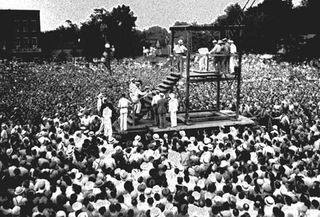
Even novice American legal historians likely know that there is a long tradition of public executions in the United States. Thus tradition and constitutional originalism would not seem to suggest obvious reasons why modern executions should have to be kept secret. (The picture above is a (in)famous photo of the last public hanging in the United States which took place in Kentucky in 1936. The website Execution Today has this effective account of the execution.)
Perhaps more importantly, as this Georgia case highlights, there is on-going uncertainty and widespread litigation about the efficacy of, and circumstances surrounding, modern lethal injection protocols. For this reason, I asked more than four years ago in this post “Shouldn’t all executions now be recorded on video?”, and I continue to see the legal value and litigation importance of making a visual record of all modern executions.
Of course, I fully acknowledge that any video recording of an execution could be misused, but the same can be said for lots of video of government functions. Moreover, I think transparency and public access to important governmental activities ought to be a paramount concern in these kinds of debates. (But, of course, my interests here are surely influenced by my role as an academic and blogger, and I might feel very different were I a participant in an execution.)
Some older related posts: