
Lots to good reasoning on crime and punishment at Reason
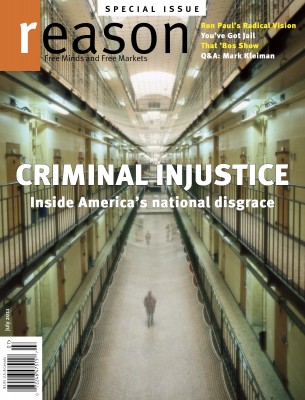
At the first presidential debate of the 2012 campaign, former New Mexico Gov. Gary Johnson implored Republican voters to conduct a “cost-benefit analysis” of the criminal justice system. “Half of what we spend on law enforcement, the courts, and the prisons is drug related, and to what end?” Johnson asked a South Carolina audience in May. “We’re arresting 1.8 million a year in this country; we now have 2.3 million people behind bars in this country. We have the highest incarceration rate of any country in the world. I would ask people to look at this issue; see if they don’t come to the same conclusion that I did, and that is that 90 percent of the drug problem is prohibition-related.”
The ends of justice, Johnson argues, have not justified the means of prosecution. This issue of reason is a detailed brief in support of that thesis. A system designed to protect the innocent has instead become a menagerie to imprison them. A legal code designed to proscribe specific behavior has instead become a vast, vague, and unpredictable invitation to selective enforcement. Public servants who swear on the Constitution to uphold the highest principles of justice go out of their way to stop prisoners from using DNA evidence to show they were wrongly convicted. Even before you start debating the means of the four-decade crackdown on crime and drugs, it’s important to acknowledge that the ends are riddled with serious problems.
And here are the three major article that follow this introduction in the magazine:
- “Prison Math: What are the costs and benefits of leading the world in locking up human beings?“
- “Locked Up, Locked Out: The social costs of incarceration“
- “Wrongful Convictions: How many innocent Americans are behind bars?“
The “social costs” article, authored by Harvard sociology Professor Bruce Western, includes these important insight:
Do prisons make us safer? By taking would-be offenders off the streets, prisons clearly have reduced crime in the short run. In the long run, though, imprisonment erodes the bonds of work, family, and community that help preserve public safety.
Three effects are fundamental. First, former prisoners do worse economically than if they had never been incarcerated. We can see some evidence in a study I conducted in 2004 with the Princeton sociologist Devah Pager. We ran an audit experiment that sent trained testers to apply for more than 1,000 entry-level jobs throughout New York City. The fake job applicants were dressed similarly, gave similar answers, and provided résumés with identical education and work experience. At each job interview, however, one randomly chosen tester would tick the application box indicating a criminal record and submit a résumé that mentioned a prison and provided a parole officer as a reference.
White testers who were assigned a criminal record received call-backs or job offers from employers only half as often as testers with clean records. For African Americans, a criminal record reduced employment opportunities by two-thirds. Labor force data from the National Longitudinal Survey of Youth paint a similar picture of incarceration’s negative effects: Wages fall by about 15 percent after prison, yearly earnings are reduced by about 40 percent, and the pay of former prisoners (unlike compensation for the rest of the labor force) remains stagnant as they get older.
The second important effect of imprisonment falls not on ex-inmates but on their families. About half of all prison and jail inmates are parents with children under 18. By 2008 about 2.6 million children had a parent in prison or jail. By age 17, one in four African-American youth has a father who has been sent to prison.
Because of their poor job prospects, formerly incarcerated fathers are less able to contribute financially to their families. Because incarceration strains marital relations, those fathers are also less involved as parents. Compared to otherwise similar kids whose parents haven’t been behind bars, the children of incarcerated parents are more likely to be depressed, behave aggressively, and drop out of high school. These problems appear to be more common for boys than girls. Incarceration, it seems, is weakening the bonds between fathers and sons.
The third important effect of incarceration is cultural, shaping how the institutions of law and order are viewed in high-crime/high-incarceration neighborhoods. The prison population is drawn overwhelmingly from low-income inner-city areas whose residents come to associate police and the courts with the surrounding social problems of violence and poverty. Police are viewed as unhelpful, and often unaccountable, contributing to what the Harvard sociologist Robert Sampson calls “legal cynicism” in troubled, crime-ridden neighborhoods.