
“Is sending juveniles to prison for life constitutional? Judge hears arguments”
A federal judge could decide within weeks whether Michigan’s practice of sending juveniles to life in prison without parole is unconstitutional. Judge John Corbett O’Meara heard arguments this afternoon that the state’s long practice of sentencing kids as young as 14 to life in prison should be considered “cruel and unusual punishment.”
“The issue is a child is a child and they’re different,” Ann Arbor attorney Deborah La Belle argued on behalf of the ACLU and nine michigan prisoners currently serving life sentences on murder convictions they received as juveniles. One, Henry Hill, was 16, when he accompanied a group of friends to a park, where a killing took place. Hill was convicted as an accomplice and has been in prison for 28 years.
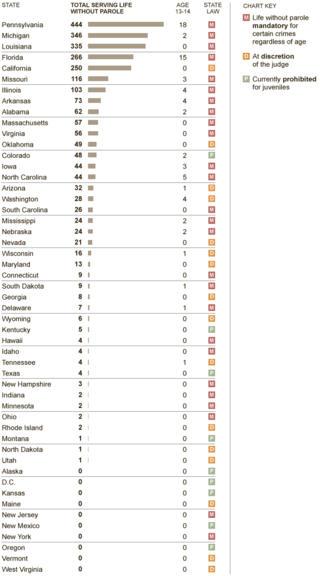
Unlike most states, Michigan has no minimum age limit when it comes to charging children as adults. Currently, there are 351 prisoners serving life sentences for murders they committed as juveniles, some as young as 14. Many were “aiders and abetters,” who served as look outs on robberies or drug deals, where a murder took place.
Attorney Margaret Nelson, arguing on behalf of the state of Michigan, which supports life sentences for juveniles, said that other states had rejected the notion that such sentences violate the Eighth Amendment prohibiting cruel and unusual punishment.
The issue of what to do with young violent criminals is part of an ongoing national debate. The United States Supreme Court ruled in 2010 that sending children to prison for non-lethal crims was unconstituitonal, but stopped short of including those convicted of first degree or felony murder. In recent weeks, the high court has signaled it may take up that issue as well.
In addition, the New York Times has this longer article about post-Graham juve LWOP issues and litigation, which is headlined “Juvenile Killers in Jail for Life Seek a Reprieve.” Here are excerpts from this piece (which also included the very informative graphic reprinted here):
Almost a year ago, the Supreme Court ruled that sentencing juvenile offenders to life without the possibility of parole violated the Eighth Amendment’s ban on cruel and unusual punishment — but only for crimes that did not involve killings. The decision affected around 130 prisoners convicted of crimes like rape, armed robbery and kidnapping.
Now the inevitable follow-up cases have started to arrive at the Supreme Court. Last month, lawyers for two other prisoners who were 14 when they were involved in murders filed the first petitions urging the justices to extend last’s year’s decision, Graham v. Florida, to all 13- and 14-year-old offenders.
The Supreme Court has been methodically whittling away at severe sentences. It has banned the death penalty for juvenile offenders, the mentally disabled and those convicted of crimes other than murder. The Graham decision for the first time excluded a class of offenders from a punishment other than death.
This progression suggests it should not be long until the justices decide to address the question posed in the petitions. An extension of the Graham decision to all juvenile offenders would affect about 2,500 prisoners….
The effort to extend the Graham decision has so far been unsuccessful in the lower courts. According to a study to be published in The New York University Review of Law and Social Change by Scott Hechinger, a fellow at the Partnership for Children’s Rights, 10 courts have decided not to apply Graham to cases involving killings committed by the defendants, and seven others have said the same thing where the defendants were accomplices to murders. Courts have reached differing results, though, where the offense was attempted murder.
All of this suggests that the question left open in Graham may only be answered by the Supreme Court. In March, lawyers with the Equal Justice Initiative asked the justices to hear the two cases raising the question.