
Budgets and litigation have shrunk California’s prison population … but not enough
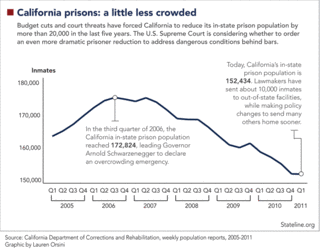
As the financially battered state enacts huge budget cuts, it has no choice but to downsize its sprawling correctional system, which now consumes 10 percent of the state budget and swallows more taxpayer dollars than higher education — a fact that, if public opinion surveys are accurate, Californians abhor. A single prison bed costs taxpayers $44,500 a year.
The federal courts have dialed up the pressure, putting state officials on notice that severe overcrowding — a fact of life in California prisons for years — is no longer acceptable. Two years ago, a panel of three federal judges found that overcrowding had created unconstitutionally inhumane conditions, ordering the state to reduce its inmate population by more than 40,000 — a staggering figure that eclipses the entire prisoner total of all but nine states.
Now, the U.S. Supreme Court is about to weigh in on the overcrowding problem by deciding whether to uphold, strike down or modify that order. Oral arguments in the case, Schwarzenegger v. Plata, made clear that the court’s decision could break along familiar ideological lines….
California’s prison downsizing efforts began before the Supreme Court’s involvement. In 2006, when the state’s inmate population reached an all-time high of more than 172,000, then-Governor Arnold Schwarzenegger declared an overcrowding emergency, warning that inmates and guards alike faced “extreme peril.”
About 10,000 inmates were promptly shipped to private prisons in Arizona, Mississippi and Oklahoma. More recently, thousands of others had their release dates moved up as state lawmakers, usually known for enhancing criminal penalties, were forced to change course. Through an expansion of so-called “good-time credits,” they authorized many inmates to leave prison ahead of schedule while reducing parole supervision for others, hoping to reduce the number sent back for relatively minor technical violations. Today, California’s in-state inmate population is down to 152,000.
Governor Jerry Brown, who took office in January, hopes to keep going. Brown wants to shift tens of thousands of low-level state inmates to county jails, even though many of those jails themselves are at capacity. If enacted, Brown’s plan could reduce the state prison population by another 38,000 within four years, according to a nonpartisan legislative estimate. It also may force counties to release thousands of offenders from their jails to make room for the state transfers….
In the notoriously divided Legislature, where budget negotiations between Brown and Republicans collapsed last week, it is difficult to find consensus on any policy, let alone one as emotionally and politically charged as prisons. Not a single Republican voted for Brown’s plan to shift inmates to the counties. And with funding for the plan now uncertain, there is discussion of leaning more heavily on spending reductions to balance the budget — cuts that could speed prisoner releases and decimate what remains of inmate rehabilitation programs.
Meanwhile, fears about a spike in crime are common. Law enforcement officials warn that more releases — whether they are ordered by the Legislature or by the Supreme Court — will have predictable long-term consequences on crime, given that parolees in California are far more likely than in other states to run into trouble again. “I’m not Nostradamus, but we have a 70 percent recidivism rate. That is a fact,” says Sacramento County Sheriff Scott Jones. “If you release 40,000 inmates, 28,000 of those will reoffend.”