
Outstanding local media coverage of the crime, prosecution and punishment of kiddle porn downloaders
The two pieces from The Virginian-Pilot — headlined “As child porn activity grows, efforts to trap offenders do, too” and “Leniency often granted in child porn cases” — do a terrific job examining and reviewing the nature of the offenders who get involved in child porn downloading and the ways in which officials catch, prosecute and sentence these offenders. Here are snippets from the main piece in the series:
The majority of offenders are white males, of all ages, with no criminal history or previous evidence of pedophilia. Researchers and therapists say the lure of child pornography, which grips addicts as intensely as crack cocaine, targets no singular class.
Offenders’ educational and occupational backgrounds vary widely: They are convenience store workers and college professors, enlisted sailors and naval officers, police officers, the homeless, and even the FBI’s own.
While the number of offenses seems small compared with, say, drug and fraud cases, child pornography was the fastest-growing crime over the past six years in Virginia – up 218 percent from 2003 to 2009. Nationally, the picture is more startling: a 2,500 percent increase in arrests in 10 years, according to the FBI. U.S. Immigration and Customs Enforcement, which handles most federal child exploitation cases, has made 12,000 such arrests since the agency was formed in 2003.
U.S. Attorney Neil MacBride, whose office is handling more such cases each year, said child pornography was a dying industry until the Internet and peer-to-peer networks developed. “It went from almost dead to now a growing epidemic,” he said….
As a result of these joint [federal and state investigating] efforts, more than 50 defendants were convicted in federal court here and sentenced to prison between March 2008 and August 2010, with prison terms ranging from one year to 40 years.
Some of the things they have discovered include: a father who dressed his toddler son up as a girl and filmed him in a sexual position; a sailor who searched for pictures of young boys being tied up and urinated on; and a Marine caught with 650,000 child porn images, some that can only be described as horrendous acts of bondage and bestiality….
[J]ust about every police department in the area now has detectives dedicated to stopping child exploitation. All of this has led to a surge in child pornography arrests in the past five years. But law enforcement officials realize they can’t arrest everyone viewing, downloading and trading child pornography. They estimate that 50,000 computers in the state contain child porn images.
ICE agents can only get to a couple of dozen a year in Hampton Roads. “When we look at the end users, we look at those who pose a threat or those who act on it, by kidnapping a child, for example,” said John Torres, special agent in charge of U.S. Immigration and Customs Enforcement for this region and Northern Virginia. “Then it’s those in a position of public trust, like teachers and police officers.”
Because ICE and the FBI have overlapping jurisdictions in this area, ICE tries to focus on the international offenders – those who produce and distribute child porn from far away places like Russia – while the FBI zeroes in on domestic online predators. Producers and sellers of child pornography have been arrested in California, Pennsylvania, Florida, Spain, the Netherlands and Russia….
Typically, detectives troll the Internet posing as children or acting as child porn collectors, said Sgt. Terry Wright of the Bedford County Sheriff’s Department. “I would say that the past few years it has grown exponentially,” he said. “Everything is getting cheaper and faster. It just proliferates the problem.” A pattern he sees repeated in offenders is that they start with adult porn but get bored and turn to child porn.
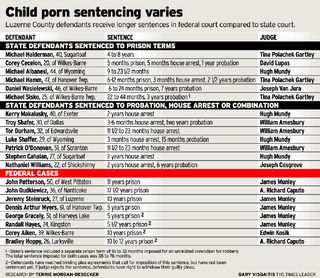
The two pieces from The Times Leader — headlined “Feds, Pa. differ on kid porn: There are reasons for the wide variety in sentencing, experts say; But some still see inconsistency and unfairness” and “Real-world danger of porn offenders uncertain
When officers with an Internet task force raided John Patterson’s West Pittston home in November 2008, they discovered 279 images of child pornography stored on numerous hard drives hidden throughout his residence.
Thirteen months later members of the same task force made another big bust when they raided Michael Albanesi’s home in Wyoming and recovered computer hardware with 507 images of child pornography.
The cases were strikingly similar in terms of the allegations. Both Albanesi and Patterson, neither of whom had a prior record, admitted they had been downloading and trading child porn images with others over the Internet for years. Each man faced the potential of dozens of years in prison.
So why, then, is Patterson serving 11 years in prison, while Albanesi was sentenced to just nine-to-23 months? The answer lies primarily with one key difference between the cases: Patterson was prosecuted by federal authorities, while Albanesi’s case was handled in Luzerne County Court.
The cases are but one example of the widely disparate sentences being levied in child pornography cases that have led some within the justice system –- including federal judges -– to question the fairness of federal sentencing guidelines.
In 2009 the average sentence imposed in federal court on a defendant for possessing and or disseminating child pornography was 7 years, according to the United States Sentencing Commission’s annual report.
Defendants who were prosecuted in a Pennsylvania state court faced much less severe sentences, according to statistics from the Pennsylvania Commission on Sentencing. A total of 76 defendants were sentenced in 2009. Of those, 36, or 47 percent, were sentenced to probation, while two defendants, or 3 percent, were sentenced to house arrest or some other punishment that did not involve incarceration.
Of the 38 defendants who were sentenced to prison, 21 percent received state prison sentences ranging from 33 months minimum to 98 months maximum, while 29 percent received county prison sentences ranging from a minimum of five months to a maximum of 22 months.