
Could and should vehicle crash deaths and costs be deterred by tougher punishments?
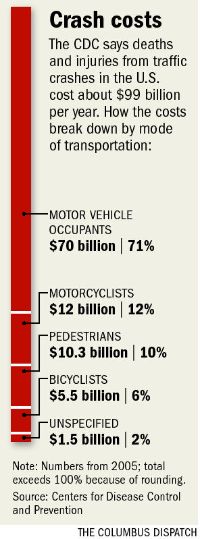
Regular readers know that, ever the utilitarian punishment fan, I have long thought that the many significant harms that result from drunk driving could and should justify a tougher criminal justice approach to this seemingly deterrable and very costly crime (see some of the posts linked below). Now, this notable new article in my local Columbus Dispatch, which is headlined “CDC: Beef up traffic laws,” has me wondering if we should get tougher on all driving crimes, not just drunk driving. Here is the factual background concerning some of the (very preventable?) costs that may result from our unwillingness to be tough enough with out driving rules and regulations:
Traffic deaths and injuries are a preventable scourge that cost the nation about $99 billion a year in medical bills and lost productivity, according to the U.S. Centers for Disease Control and Prevention.
That’s about $500 for each licensed driver in America, according to a study by the CDC’s National Center for Injury Prevention and Control. Researchers tallied the costs nationally using hospital, insurance and other data from 2005, when there were 3.7 million deaths and injuries from crashes.
They hope the cost information will persuade states and communities to take action to prevent traffic crashes, said Rebecca Naumann, a CDC epidemiologist and lead researcher on the study. Action would include requiring motorcycle riders to wear helmets, allowing police to pull drivers over simply if they’re not wearing a seat belt and checking for drunken driving at checkpoints….
Ohio has put in place several strategies to reduce traffic deaths and injuries that the CDC mentioned in its study, including graduated driver’s licensing for teens. Deaths and injuries from crashes among 15- to 19-year-olds cost $11.2 billion, the CDC study found….
There’s also political resistance to motorcycle helmet laws, red-light cameras and primary seat-belt laws, which allow an officer to stop a driver just for not buckling up. “People clamor for drugs that will treat serious diseases, but with motor vehicle crashes, there’s often resistance,” [Russ] Rader [of the Insurance Institute of Highway Safety] said. “There is reluctance on the part of politicians to tackle some of these things because of the vocal opponents they would have to cross to get it accomplished.”
One thing that’s not mentioned in the CDC study is bans on texting or cell-phone use. The insurance institute’s studies of states with and without bans shows no evidence that they cut crashes, Rader said. “We want to know whether the laws being passed are reducing crashes, and the cell-phone laws are not doing that,” he said.
Critically, I do not want or mean to suggest that imprisonment is the ideal or even a sound way to toughen punishment for risky driving behaviors. Supersized fines (perhaps in the day-fine model used in much of Europe) or shaming sanctions or community service obligations could well be much more effective in encouraging the average driver to stay sober, slow down, buckle up and save all of us $99 billion that crashes cost all of us each year.
As my 1L students discover each year, I think driving laws and punishments provide an effective window into whether one is drawn to more utilitarian or more retributivist approaches to sentencing law and policy. The costs stressed by the CBC suggest that we could improve society greatly by being (creatively) tougher on those who engage in what we know to be risky driving behaviors. But to achieve such a utilitarian bang for our buck, we will surely risk punishing some (many?) drivers more than some (many?) persons might think these drivers deserve.
Personally, in this particular (and I think particularly important) context, I would generally rather run the risk of over-punishment of some risky drivers (including myself) than run the risk of more risky drivers on the roads threatening my friends and family. But, as suggested above, if/when the form of “over -punishment” in this setting were to be significant jail/prison time (which is itself economically and socially costly), the utilitarian (and my normative) calculus could come out differently.
Some related posts on sentencing drunk drivers:
- Effective commentary complaining about undue leniency for drunk drivers
- Getting tougher on drunk driving
- Why do we worry so much more about sex offenders than drunk drivers?
- Technology versus toughness to combat drunk driving
- Undue leniency for drunk drivers?
- More discussion of leniency for drunk drivers
- Is capital punishment for drunk driving morally required?
- More examples of undue leniency shown to repeat drunk drivers
- “Some Coloradans drive until they kill”
UPDATE on 9/7: Though the discussion in the comments to this post have been going hot and heavy, I figured this amusing local news story from Ohio could give it some additional juice: “Police: Driver distracted by sex toy.” Here are the essentials:
An Elmwood Place police officer who stopped a car because it had illegally tinted windows received a bit of a shock when he looked inside.
Officer Ross Gilbert said the driver, Colondra Hamilton, a 36-year-old Downtown resident, was sitting with her pants unzipped and a sex toy in her lap. He said Hamilton told him she was using the toy while watching a sex video on a laptop computer that a passenger in the front seat held up so she could see it.
Gilbert charged her with “driving with inappropriate alertness” and having illegal tinted windows, according to the traffic ticket.