
“Trial and Error in Criminal Justice: Learning from Failure”
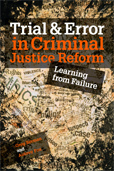
When it comes to criminal justice reform, neither citizens nor officials have endorsed the view that problems are solved iteratively. Reluctance to be associated with programs judged failures has stifled innovation and kept criminal justice reformers spinning their wheels.
Trial and Error in Criminal Justice Reform: Learning from Failure argues that public policies cannot be neatly divided into successes and failures. The book examines well-intended programs that for one reason or another fell short of their objectives (D.A.R.E. and Operation Ceasefire being prime examples) yet also had positive effects. Greg Berman and Aubrey Fox tell the stories of committed reformers — judges, cops, attorneys, parole officers, researchers, educators, and politicians — who, despite their knowledge and ambition, did not quite achieve their goals. They introduce readers to a parole officer who has to make a tough judgment call, a legislator who endures political pressure to rewrite sentencing laws, a judge who attempts a new response to drug offenses despite local resistance, and many others.
I have had a chance to read parts of this book already, and I find it fascinating. Here also is a comment about some of the themes of this important book that I received from one of the authors:
The vast majority of what police, prosecutors, defenders, correctional officials, probation officers and judges do on a daily basis is not supported by strong, scientific evidence.
Indeed, there is an enormous gulf between frontline criminal justice practitioners and social science researchers. One sign of this is the field’s resistance to the scientific method — the process of trial and error. In general, criminal justice officials don’t feel they have the latitude to talk honestly about a simple reality: new initiatives are just as likely to fail as they are to succeed.
This is a point that Aubrey Fox and I make in Trial and Error in Criminal Justice: Learning from Failure. Over the course of researching the book, we learned a number of important lessons, including the challenge that criminal justice officials face in trying to meet the often-unrealistic expectations of elected officials and the general public. There are no silver bullets when it comes to changing the behavior of offenders or reducing crime in hard-hit urban neighborhoods.
But perhaps the most important lesson we learned is that the closer one looks, the harder it is to draw a clear, defining line between what works and what doesn’t in criminal justice. Initiatives like drug court and Operation Ceasefire that succeed spectacularly in one place can fail miserably in another. Even the drug prevention DARE, which is almost universally reviled by researchers, has achieved some positive results in some jurisdictions.
In a perfect world, it would be nice to be able to make black-and-white judgments about reforms…. But like so much of life, criminal justice is dominated by shades of grey. Acknowledging this reality is crucial if we ever hope to have an honest, rational conversation about criminal justice policy in this country.