
New York Times op-ed urging “Getting Smart on Crime”
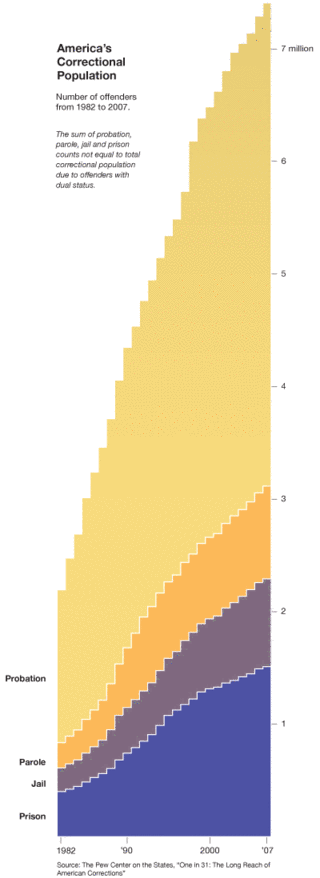
Much of the rise in the prison population was because of draconian mandatory sentencing laws that are illogical — sociologically and economically.
On the sociological side, as the criminal justice expert Joel Dvoskin of the University of Arizona explained to me, data overwhelmingly support the idea that locking up low-risk, nonviolent offenders makes them worse, not better.
A study from a decade ago that was published in the journal American Psychologist put it this way: “Department of corrections data show that about a fourth of those initially imprisoned for nonviolent crimes are sentenced a second time for committing a violent offense. Whatever else it reflects, this pattern highlights the possibility that prison serves to transmit violent habits and values rather than to reduce them.”
On the economic side, putting nonviolent drug offenders in rehab is cheaper than putting them in prison. A 2006 U.C.L.A. study found that California’s Substance Abuse and Crime Prevention Act of 2000, which allowed nonviolent drug possession offenders to go to rehab instead of prison, saved taxpayers nearly $2.50 for every $1 invested in the program. (Unfortunately, funding for the program has been gutted.)
Put them in prison and make them worse criminals, or put them in rehab, possibly make them better, and save some money. Sounds like a no-brainer.
There are encouraging signs that policy makers are moving in the right direction. Many states have moved to repeal mandatory minimums, and there is a bill in Congress to repeal federal mandatory sentencing. Furthermore, Attorney General Eric Holder seems to be thinking about this issue the right way. Speaking to the American Bar Association last week, he said, “There is no doubt that we must be tough on crime. But we must also commit ourselves to being smart on crime. … We need to adopt what works.”
Some recent related posts:
- AG Holder continues to talk about being “smart on crime” (and other important stuff)
- A pair of timely reports on state correction costs
- “The Fiscal Crisis in Corrections: Rethinking Policies and Practices”
- Reviewing how tough times are resulting in prison releases
- “Prison spending still shackles state budget”
- The state of cost problems in the states of prison nation
- “To Cut Costs, States Relax Prison Policies”
- Will we invest in classrooms or cells in these tough times?
- Federal judicial panel orders California to drastically cut prison population
- “Free 40,000 California inmates? Not so fast.”
- Prison reforms and cuts left uncertain in final California budget deal
- Economic necessity finally forcing long-needed reform in California