
A new opportunity to assess the economy/crime rate connection
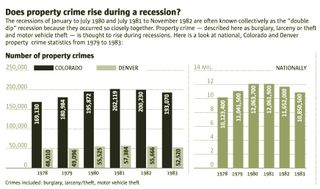
The number of reported burglaries, car thefts and larcenies has dropped steadily in several Colorado cities despite historic data that say crime should be on the rise during this deep economic recession.
The decrease puzzles criminologists but gives police reason to tout crime-prevention initiatives and tougher sentencing laws putting prolific burglars and car thieves away. Yet even the police aren’t sure of all of the factors driving the phenomenon. “Perhaps it would be a natural assumption that crime would increase when the economy is bad,” said Detective Shannon Lucy of the Aurora Police Department. “It does kind of go against what people would expect.”
It may be too early in this recession to see whether the downward crime trend holds. Some who are young, poor and uneducated may yet be driven to crime after repeated failed attempts to find jobs, some experts said. “People don’t become criminals overnight. It takes some time for the strain to hit them,” said Jeff London, assistant professor of criminology at Metropolitan State College of Denver.
Between 1979 and 1981, when wages dropped 20 percent, the number of property crimes reported jumped 18 percent nationwide, following a long-established pattern in which recessions cause crime to spike. Colorado experienced a similar leap of 18 percent in property-crime numbers between 1979 and 1981, according to Colorado Department of Public Safety reports.
But during the current recession, several Colorado communities, including Denver, Thornton and Aurora, are seeing double-digit-percentage declines. Statewide totals for 2008 won’t be available for two months.
But while the numbers look promising for getting through the recession without a crime spike, there are dominoes yet to fall. Mass layoffs during a recession force people with master’s degrees to seek jobs normally taken by those with bachelor’s degrees, who, in turn, take openings normally taken by less-educated youths, who find it increasingly difficult to find any job. It also takes time for people to run out of unemployment benefits.