
The Economist urges “Rethinking Prison”
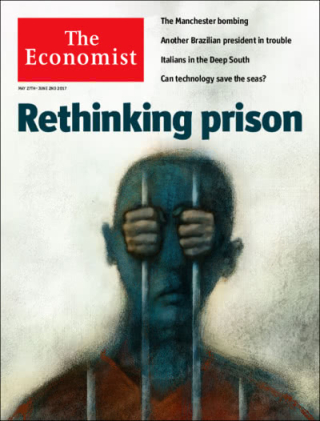
“America’s prisons are failing. Here’s how to make them work: A lot is known about how to reform prisoners. Far too little is done.”
“More women are being put behind bars. Fewer should be: Female convicts are less violent and more likely to have stolen to support children
“Too many prisons make bad people worse. There is a better way: The world can learn from how Norway treats its offenders”
Here is an excerpt from the last of these articles:
Reserving prison for the worst offenders has hefty benefits. First, it saves money. In America, for example, incarcerating a federal convict costs eight times as much as putting the same convict on probation. Second, it avoids mixing minor offenders with more hardened criminals, who will teach them bad habits. “The low-level guys don’t tend to rub off on the higher-level prisoners. It goes the other way,” says Ron Gordon of the Utah Commission on Criminal and Juvenile Justice, a state body.
Modern electronic tags are cheap and effective. In a recent study Rafael Di Tella of Harvard University and Ernesto Schargrodsky of Torcuato Di Tella University compared the effects of electronic tagging versus prison for alleged offenders in Buenos Aires. Earlier research had failed to deal with the fact that criminals who are tagged are less likely to reoffend than the more dangerous ones who are locked up. The authors found a way round this. Alleged criminals in Argentina are assigned randomly to judges for pre-trial hearings. Liberal judges are reluctant to hold them in the country’s awful jails, so they often order them to be tagged. So-called mano dura (tough hand) judges prefer to lock them up. The researchers observed what happened to similar offenders under different regimes. Only 13% of those who were tagged were later rearrested; for those sent to prison the figure was 22%.