
In memoriam: mourning the passing of Judge Jack Weinstein
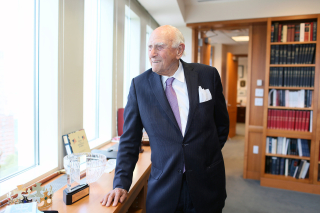
This personal story is my preamble to a post meant to honor Judge Weinstein for his contributions to all areas of the law upon news today of his passing at age 99. I am pleased to see that this New York Times article about his life includes an extended discussion of his sentencing practices:
Judge Weinstein often said that the individual before the courts was their highest responsibility, a concern he made obvious in criminal cases. As a senior judge concerned about wrongful detentions and other abuses of defendants’ rights, he took on nearly 500 backlogged habeas corpus cases, and read them all. When sentencing criminal defendants, he sat at a table with them instead of looking down from a bench. In court, he almost always wore a business suit instead of robes.
Judge Weinstein viewed federal sentencing guidelines as a betrayal of the moral imperative that the punishment should fit the crime. When he took senior status and could refuse cases, he stopped hearing minor drug cases. “I have become increasingly despondent over the cruelties and self-defeating character of our war on drugs,” he wrote in a Times opinion essay in 1993, noting that 60 percent of federal prison inmates were drug offenders.
In a 2004 law review article, speaking of “grotesque over-sentencing” required by drug laws, Judge Weinstein wrote that if judges left the bench to avoid enforcing unjust laws, they risked being replaced by “government puppets.” The legal system, he said, could and should accommodate judicial protest. He later resisted the federal five-year mandatory minimum sentence for downloading child pornography, throwing out several convictions to avert what he called “an unnecessarily harsh and cruel sentence.”
There is, of course, so much more to be said about Judge Weinstein’s contribution to the law and practice of sentencing. Fortunately, as noted in this prior post, the Federal Sentencing Reporter was able to produce earlier this year an issue entirely devoted to “Weinstein on Sentencing” to celebrate his many contributions to federal sentencing law, policy and practice.
FSR was fortunate to get two of Judge Weinstein’s former clerks, Carolin Guentert and Ryan Gerber, to organize this great issue. They did an extraordinary job gathering an array of perspectives in an issue that includes a considerable number of original articles under the heading “Celebrating Judge Weinstein” as well as excerpts from Judge Weinstein’s past opinions and articles under the heading “Weinstein In His Own Words.”
On a day in which tradition dictates saying “May his memory be a blessing,” I highly encourage everyone to check out this full FSR issue in order to help burnish great memories of the great sentencing work of this great man.