
AGAIN: You be the judge: what sentence for Michael Avenatti (and do the guidelines merit any respect)?
——————————————————————————-
It has been a while since I have done a “you be the sentencing judge” post, but a high-profile fallen lawyer provides juicy grist for this mill. Specifically, as two recent postings at Law & Crime highlight, Michael Avenatti’s upcoming sentencing presents a notable set of facts and arguments for SDNY US District Judge Paul Gardephe:
Feds Seek ‘Very Substantial’ Prison Term for Disgraced Lawyer Michael Avenatti
Valuably, these two postings include the extended sentencing memoranda filed by the parties in this case, and the second posting summarizes the terms of the sentencing debate (with some of my emphasis added):
Scoffing at the one-time celebrity lawyer’s claim that his “epic fall and public shaming” should be taken into account at sentencing, federal prosecutors urged a judge to deal Michael Avenatti a “very substantial” prison sentence for attempting to extort Nike out of millions of dollars by threatening to expose their corruption scandal.
Quoting the probation office, prosecutors noted that Avenatti “often put himself forth as a champion for the Davids of the world, facing off with those Goliaths who would bully the small, the weak, the victimized.”
“And it was precisely this reputation, and the enormous influence that the defendant wielded on the national stage and across media platforms, that he weaponized,” Assistant U.S. Attorney Matthew Podolsky wrote in a 19-page sentencing brief on Wednesday night. “He used his skills as a lawyer and his power as a media figure not to benefit his client, but instead to threaten harm in an effort to extract millions of dollars from a victim, which, while sophisticated, [Avenatti] believed would be forced into acquiescing secretly to his demands.”
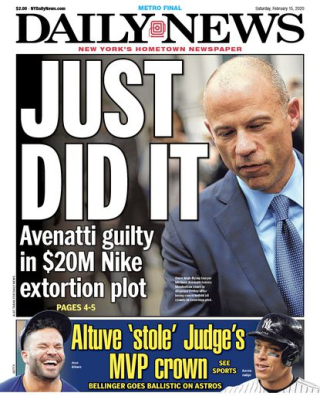
Once a fixture of the cable TV commentary rounds, Avenatti previously depicted his prosecution as another David-versus-Goliath fight, pitting him against the combined might of the Nike corporation and the Trump administration. Southern District of New York prosecutors rejected that, and a federal jury convicted him on all counts in February 2020.
Earlier this month, Avenatti’s defense attorneys Scott A. Srebnick and E. Danya Perry argued that a six-month maximum sentence would be enough for their client. They also said the court could take “judicial notice” that Avenatti’s well-documented “epic fall […] played out in front of the entire world.” Federal prosecutors found that sort of sentence would be far too light, and though they did not propose another number, their sentencing memorandum leaves a few clues into their thinking.
The probation office proposed an eight-year sentence, which dips below the 11.25-to-14-year guideline range. “While the government, like the probation office, believes that a below-guidelines sentence would be sufficient but not greater than necessary to serve the legitimate purposes of sentencing, the government asks this court to impose a very substantial sentence,” prosecutors wrote….
During the trial, prosecutors played a tape for jurors that they called a picture of extortion. “I’ll go take $10 billion off your client’s market cap,” Avenatti was seen warning attorneys for Nike in the videotape, referring to capitalization. As the jury found, Avenatti had been talking about confidential information he learned about Nike from his former client Gary Franklin, an amateur basketball coach. Avenatti threatened to expose the embarrassing information relating to the corruption scandal unless the Nike paid $15 million—”not to Franklin, but directly to the [Avenatti] himself,” prosecutors noted. According to the memo, the deal represented 10 times more than Avenatti asked Nike to pay Franklin, and it would have resolved his client’s claims against Nike….
Franklin wrote separately to the U.S. District Judge Paul Gardephe harshly criticizing Avenatti. “Mr. Avenatti quickly abused that trust when he announced on Twitter, without my knowledge and without my consent, that he would be holding a press conference to discuss a scandal at Nike that ‘involved some of the biggest names in college basketball,’” Franklin wrote in a two-page victim impact statement. “I never imagined that Mr. Avenatti would proceed to post on Twitter details of the information I had relayed to him as part of our attorney-client privileged discussions, including the names of the players I coached.
Franklin is not alone among Avenatti’s spurned former clients. Avenatti continues to face another federal prosecution in New York accusing him of defrauding Stormy Daniels in a book deal, plus a case in California alleging tax offenses and other misconduct.
There are so many elements to both the Avenatti crime and his background that may (or many not) be considered important in his upcoming sentencing. But, as my post title and emphasis seek to highlight, there is seemingly a consensus that the federal sentencing guidelines come nowhere close to recommending a proper sentence. It is, of course, not especially surprising when a criminal defendant requests a sentence way below the applicable guideline range. But here, notably, both the probation office and seemingly federal prosecutors also believe a proper sentence should be many years below the bottom of the applicable guideline range.
So I sincerely wonder, dear readers, what sentence you think would be, in the words of the prosecutors, “sufficient but not greater than necessary to serve the legitimate purposes of sentencing”? Do the guideline merit any respect in this analysis?