
A deep dive into extreme sentences in the Pelican State
Louisiana sentences people to life without parole at one of the highest rates in the nation, data shows. Nearly 4,200 men and women are serving lifetime sentences in the state, for crimes that range from homicide and rape to rarer cases of repeat purse snatchings and child neglect, an investigation by The Marshall Project and The Times-Picayune | The Advocate found.
Second-degree murder charges, like the ones Woods and Scott were found guilty of, are a big driver of life-without-parole sentences. The state has long had the highest homicide rate in the nation. But Louisiana law contains an unusually sweeping definition of second-degree murder that includes even some accidental deaths, legal experts say. And despite the wide variations in circumstances that can produce a second-degree murder conviction — from a premeditated ambush to a getaway car accident — the sentence is the same: mandatory life without parole. Judges have almost no discretion.
Total medical spending for state corrections eclipsed $100 million last year. That’s an increase of about 25% from 2015, according to state budget figures….
Now, one in six people incarcerated in Louisiana has been sentenced to die in state custody. Nearly 1,200 lifers are over 60. Those geriatric lifers make up nearly 5% of the state prison population.
“A life sentence for $20 of weed? Louisiana stands out for its unequal use of repeat offender laws.“
The crime that landed Kevin O’Brien Allen a spot among the more than 4,100 Louisianans now serving life-without-parole sentences wasn’t a bloody one: He sold $20 in marijuana to a childhood friend….
Agents booked Allen on two counts of marijuana distribution, and prosecutors in District Attorney Schuyler Marvin’s office made him an offer: a 5-year sentence if he pleaded guilty. Allen, a father of two with a steady job but a handful of drug convictions, balked….
Louisiana law affords prosecutors wide discretion to increase a repeat offender’s sentence, up to life, and Marvin’s office drew on Allen’s past convictions: possession with intent to distribute marijuana in 2004, marijuana possession in 2007 and 2011, and methamphetamine possession in 2013.
Once invoked by a prosecutor, the habitual-offender law gives little leeway to judges. They can sentence a defendant to less time if they find the minimum is so far out of line that it defies “acceptable goals of punishment” or serves as “nothing more than the purposeful imposition of pain and suffering.” But courts have described those scenarios as “exceedingly rare.”…
Allen [received a life sentence and] now works in the prison kitchen, making juice for pennies a day, serving a sentence that ends when he dies. He’s among nearly 300 people serving life without parole in Louisiana prisons based on their status as habitual offenders, an analysis of recent state corrections data show. In 40% of those cases, the incarcerated person is locked up for life on a non-violent crime….
Corrections data show wide variances in how district attorneys around the state have used the habitual offender law. Nearly two-thirds of habitual lifers in the state were sentenced in one of four large parishes: Caddo, Orleans, St. Tammany or Jefferson, according to the data. The practice is somewhat less common in East Baton Rouge Parish, the state’s most populous.
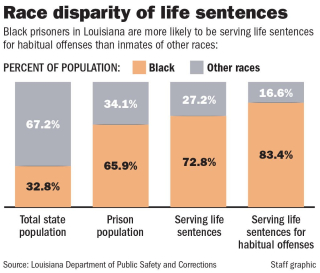
Overall, Louisiana prosecutors have mostly aimed the law at Black defendants, like Allen. Black people make up 31% of Louisiana’s population, but 66% of its state prisoners; 73% of those serving life sentences; and 83% of those serving life as habitual offenders, corrections and census data show.