
Shaming t-shirts ordered as part of community service sentence
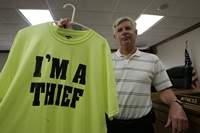
Given that shaming sentences would seem to have special appeal during lean economic times when the costs of traditional punishment are of great concern, I am somewhat surprised that there has not been more discussion and debate of these kinds of innovative sentences lately. But, as highlighted by this recent article from the Toledo Blade, which is headlined “Fashion police: Judge tailors punishment that fits criminals to a T,” the use of shaming sentences remains alive and well at the local level. Here are excerpts from this story:
I did the crime, I did the time, and all I got was this lousy T-shirt. Such a reaction could crop up in Fulton County, where a no-nonsense judge is requiring some criminals to wear customized clothing in public: neon green shirts with large, black letters announcing, “I’m a thief.”
To curb crime and provide a form of public punishment, Western District Court Judge Jeff Robinson recently introduced the “criminali-tees,” and so far several convicted shoplifters, while performing community service, have worn the garish, attention-grabbing garments.
The shirts aren’t designed to be a fashion statement, but rather a statement of fact, a wash-and-wear way to help weave criminals back into the social fabric. Public punishment, the judge said, serves as a deterrent, particularly at a time when more people are being tempted to steal from others.
When the economy started to tank, the judge noticed “what appeared to be a huge uptake in the number of shoplifting cases occurring in the community.” During one proceeding, he asked a thief how she expected to get away with stealing stuff from a busy retail store, and she seemed rather proud to know security cameras can’t spot shoplifters in a particular area, he said.
After that, he decided shoplifters needed to “suffer a little bit of humility.” And, he said, a message needed to be sent to others that being a thief isn’t something they want to get involved in. The shirts, the judge said, are not worn with a sense of pride, and the message appears to be having its desired effect. “Shoplifting cases are down,” he said, but he added that the shirts alone aren’t the reason. Enforcement efforts have stepped up….
Mr. Robinson, a judge since 2005, admits customized clothing for criminals isn’t a new idea. A judge in Defiance County, who is now retired, “had a whole parcel of shirts for juveniles” to wear, he said….
Mark Powers, a lawyer in Fulton County who represents clients who come before Judge Robinson, said he’s aware of the shirts, but hasn’t seen anyone wearing one in public. So far, none of his clients has been ordered to wear them, but “I am sure that will happen,” he said. And when it does, he’ll be OK with it, even if his clients aren’t.
“Quite frankly, the idea is to get people to not do this and if that is an effective way to not do that, it serves its purpose,” Mr. Powers said. It’s sort of like the old days of pillory, Mr. Powers said, when people were punished by public humiliation, with heads and hands secured in a metal or wooden framework device. “If it keeps them from doing it again, it wasn’t the worst thing to try to do.”