
Illinois prisons bursting following end of early release program
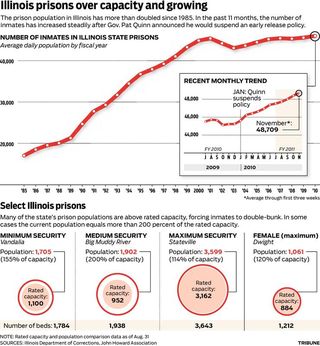
I just came across this notable recent piece from the Chicago Tribune, which is headlined “Illinois prison population surges to record high: Backlash over Quinn’s early-release program plays role.” Here is how it begins:
Hard time has gotten even harder in Illinois prisons. The state’s prison system is bursting at the seams with a record high of nearly 49,000 inmates, some 3,000 more than just a year ago. The surge, combined with the state’s multibillion-dollar budget crisis, has led to conditions that watchdog groups and veteran correctional officers say they haven’t seen since a population crisis in the 1980s prompted the state to build three new prisons.
Confronted with putting more offenders in the same amount of space, administrators are doubling up every available cell. As many as four inmates are bunked in slightly larger cells intended for two handicapped prisoners. At the intake facility at Stateville near Joliet, incoming inmates regularly sleep on cots in a gymnasium or prison hospital.
Guards say overcrowding provides fewer disciplinary options — some prisons have been pressed into holding problem inmates in “segregation” in the same areas as regular inmates. Overcrowding also leads to more inmate assaults on staff, guards say.
With the Illinois Department of Corrections about $95 million behind on its bills, many prison vendors haven’t been paid for months. In some cases, fed-up contractors have stopped extending credit to prisons, causing shortages that have led wardens to barter among themselves to stay stocked with essential items like paper goods and soap.
It’s a marked change for Illinois, which a year ago saw its prison population drop, a trend seen in about half of the country as cash-strapped states looked to alternatives to incarceration to reduce spending, according to a Pew Center report.
Three years ago, thinking that the number of inmates statewide would stabilize or even fall, prison officials in Illinois considered closing Vandalia Correctional Center to cut costs. But in just the last year, the population at the downstate minimum-security prison nearly doubled, rising to 1,700 this fall from 950 last November. Now, nearly 100 inmates sleep dormitory-style in a basement area previously closed off by prison officials, said Russ Stunkel, president of the union representing staff at Vandalia. The bunks are only about 2 feet apart — rear end to elbow, as he put it. “We’re beyond our capacity, and I don’t think we can handle any more,” Stunkel said.
The reason for the rising numbers of inmates over the last year has nothing to do with more offenders entering the system — it has to do with fewer getting out as the result of a backlash against a policy change by Gov. Pat Quinn that allowed the early release of about 1,700 inmates over four months.
Under fire by an opponent in a heated primary fight, Quinn in January suspended the controversial program, called Meritorious Good Time Push, after news media reports that some prisoners sentenced to short terms of incarceration were freed after as little as a few days in state prison under the program. At the same time, Quinn also suspended the state’s regular Meritorious Good Time program, which had been in place for three decades and reduced the prison time of nearly two-thirds of the state’s inmates by an average of a few months.
As a result, the prison population began rising immediately and has gone up every month since, reaching a peak of 48,731 last week.