
“California ‘three-strike’ sentences used less often 15 years later”
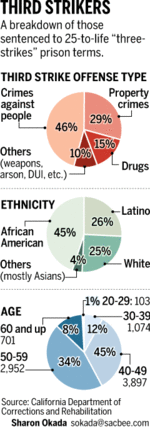
Fifteen years after passage of the state’s landmark “three strikes” sentencing law, prosecutors in Sacramento and throughout California have become far more selective in applying the full force of the statute, reducing the number of lifetime prison terms being sought for third strikers to a relative trickle.
While it used to obtain the maximum sentences anywhere from 50 to nearly 100 times a year, the Sacramento District Attorney’s Office now asks for life terms for third strikers fewer than 20 times a year, according to the California Department of Corrections and Rehabilitation. The office obtained 16 such sentences in 2010 compared with a high of 94 in 1996…..
District attorneys across the state used to collectively pack off criminals on maximum three-strikes terms by the hundreds — more than 1,700 in 1996 alone. In the past three years, the numbers have dropped to well short of 200 annually. California prisons housed 8,727 three-strike lifers as of Dec. 31.
Explanations for the decrease vary. One factor, said legal experts, is the 1996 California Supreme Court decision that gave judges a say in three-strikes sentencing. They also point to a basic supply-side issue: Voters and lawmakers have approved a collection of tough sentencing laws that have depleted the pool of eligible offenders earlier in their criminal careers, taking them off the streets before they qualify for 25-to-life terms under the three-strikes statute.
Sacramento prosecutors say they’ve simply gained a better sense of which offenders truly deserve the harshest measure of the law. “Have we evolved over time? Yes,” said Sacramento County District Attorney Jan Scully, whose 17-year tenure in office closely tracks the history of California’s three-strikes law.
But she also believes there just aren’t as many people to sentence anymore, noting Sacramento County has imprisoned 557 offenders on 25-to-life terms since the law went into effect. “Not just in Sacramento but across the state, we’ve put away people on three strikes and they aren’t now in our communities,” Scully said.
Passed by the Legislature and overwhelmingly approved by voters in 1994, the three-strikes law can be used to impose 25-to-life prison terms on repeat serious and violent offenders if they pick up a third felony, no matter how minor. It also doubles prison terms for new offenders with single past convictions for serious or violent felonies.
Prosecutors have always had discretion under the law to reduce potential life terms to lesser sentences, but many didn’t exercise it. Los Angeles County prosecutors, in particular, refrained from “striking strikes,” or dismissing prior serious or violent convictions for the purpose of lowering prison terms.
The approach changed when Steve Cooley was elected L.A. County district attorney in 2000. Elected largely on a platform of refining the law’s application, Cooley took the lead in putting a new policy in place. He reserved the heavier sentences for defendants with serious or violent third strikes, but built in exceptions to target offenders with horrific pasts even if their latest charge wasn’t so serious.
Cooley said over-application of the law by some California prosecutors — hitting people for third strikes for minor felonies such as drug possession and pizza theft — prompted a public backlash. A 2004 statewide ballot measure that would have dumped three strikes altogether came within three percentage points of winning.
“If you have a good law, and you abuse it, you will predictably lose it,” Cooley said at a recent symposium on the three-strikes law in Los Angeles. “If somebody has a rock (of cocaine) in his sock, you give him 25 to life? Give me a break.”
In an interview, Cooley said that Proposition 66, the 2004 initiative, “scared the bejesus out of everyone.” In its aftermath, prosecutors developed policies “to make sure we’re not very disparate in our handling of these cases,” Cooley said….
Sometimes, judges dial down life terms on their own. Over the prosecutor’s objection, Sacramento Superior Court Judge Richard K. Sueyoshi recently removed a prior strike from the complaint on defendant David C. Boult, convicted of being an ex-con with a gun. Instead of 25-to-life, Boult got 10 years and four months.
Sueyoshi’s action once would have have been impossible. The three-strikes law initially allowed only prosecutors to dismiss strikes. But the state Supreme Court, in a 1996 decision, gave judges the authority to do it.
Even with discretionary authority returned to the judges and prosecutors exercising a softer approach, plenty of critics still think the California statute is unduly harsh and applied unevenly in different parts of the state. “You still have some district attorneys out there who are still using it to capture aging felons on relatively minor third felonies,” said McGeorge School of Law professor Michael Vitiello.
In addition, Vitiello said, the prisons house thousands of offenders who are doing 25-to-life sentences whose cases may not have triggered that term today. Vitiello said the state needs a “broad sentencing scheme” overseen by an appointed commission that would review the state’s entire sentencing structure in order to reserve limited prison space for the most dangerous offenders.