
“Drug deaths now outnumber traffic fatalities in U.S., data show”
Propelled by an increase in prescription narcotic overdoses, drug deaths now outnumber traffic fatalities in the United States, a Times analysis of government data has found. Drugs exceeded motor vehicle accidents as a cause of death in 2009, killing at least 37,485 people nationwide, according to preliminary data from the U.S. Centers for Disease Control and Prevention.
While most major causes of preventable death are declining, drugs are an exception. The death toll has doubled in the last decade, now claiming a life every 14 minutes. By contrast, traffic accidents have been dropping for decades because of huge investments in auto safety.
Public health experts have used the comparison to draw attention to the nation’s growing prescription drug problem, which they characterize as an epidemic. This is the first time that drugs have accounted for more fatalities than traffic accidents since the government started tracking drug-induced deaths in 1979.
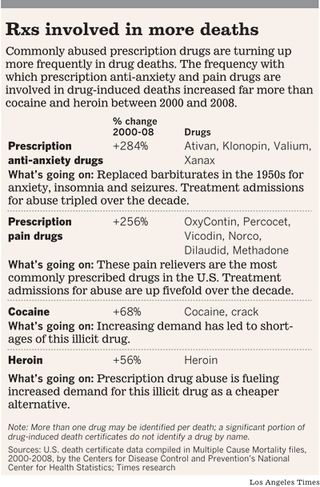
Fueling the surge in deaths are prescription pain and anxiety drugs that are potent, highly addictive and especially dangerous when combined with one another or with other drugs or alcohol. Among the most commonly abused are OxyContin, Vicodin, Xanax and Soma. One relative newcomer to the scene is Fentanyl, a painkiller that comes in the form of patches and lollipops and is 100 times more powerful than morphine. Such drugs now cause more deaths than heroin and cocaine combined….
Overdose victims range in age and circumstance from teenagers who pop pills to get a heroin-like high to middle-aged working men and women who take medications prescribed for strained backs and bum knees and become addicted.
A review of hundreds of autopsy reports in Southern California reveals one tragic demise after another: A 19-year-old Army recruit, who had just passed his military physical, took a handful of Xanax and painkillers while partying with friends. A groom, anxious over his upcoming wedding, overdosed on a cocktail of prescription drugs. A teenage honors student overdosed on painkillers her father left in his medicine cabinet from a surgery years earlier. A toddler was orphaned after both parents overdosed on prescription drugs months apart. A grandmother suffering from chronic back pain apparently forgot she’d already taken her daily regimen of pills and ended up double dosing….
The seeds of the problem were planted more than a decade ago by well-meaning efforts by doctors to mitigate suffering, as well as aggressive sales campaigns by pharmaceutical manufacturers. In hindsight, the liberalized prescription of pain drugs “may in fact be the cause of the epidemic we’re now facing,” said Linda Rosenstock, dean of the UCLA School of Public Health.
In some ways, prescription drugs are more dangerous than illicit ones because users don’t have their guard up, said Los Angeles County Sheriff’s Sgt. Steve Opferman, head of a county task force on prescription drug-related crimes. “People feel they are safer with prescription drugs because you get them from a pharmacy and they are prescribed by a doctor,” Opferman said. “Younger people believe they are safer because they see their parents taking them. It doesn’t have the same stigma as using street narcotics.”
The triumph of public health policies that have improved traffic safety over the years through the use of seat belts, air bags and other measures stands in stark contrast to the nation’s record on prescription drugs. Even though more people are driving more miles, traffic fatalities have dropped by more than a third since the early 1970s to 36,284 in 2009. Drug-induced deaths had equaled or surpassed traffic fatalities in California, 22 other states and the District of Columbia even before the 2009 figures revealed the shift at the national level, according to the Times analysis….
Drug fatalities more than doubled among teens and young adults between 2000 and 2008, years for which more detailed data are available. Deaths more than tripled among people aged 50 to 69, the Times analysis found. In terms of sheer numbers, the death toll is highest among people in their 40s. Overdose deaths involving prescription painkillers, including OxyContin and Vicodin, and anti-anxiety drugs such as Valium and Xanax more than tripled between 2000 and 2008.
The rise in deaths corresponds with doctors prescribing more painkillers and anti-anxiety medications. The number of prescriptions for the strongest pain pills filled at California pharmacies, for instance, increased more than 43% since 2007 — and the doses grew by even more, nearly 50%, according to a review of prescribing data collected by the state.
Though I am not versed in this Manning this kind of CDC data, it is worth putting these fatality numbers in context with CDC assessments of death resulting from other drugs that are even more lightly regulated that prescription pain-killers: according to the CDC here and here, in the US “tobacco use is responsible for about one in five deaths annually (i.e., about 443,000 deaths per year, and an estimated 49,000 of these tobacco-related deaths are the result of secondhand smoke exposure)” and alcohol is responsible for nearly 40,000 deaths annually attributable to liver disease or alcohol-induced deaths excluding accidents and homicides.
Any and all efforts to spin all this data are both welcome and encouraged. One might readily say these data show we waste far too much time worrying about the harms of illegal drugs and far too little time worrying about the harms of legal drugs. But one might also say that these data show how much more effective we are in preventing “collateral damage” when governments prohibit or heavily regulate a drug’s distribution rather than just leave matters largely in the hands of the marketplace as in the case of tobacco and alcohol. And, of course, just where concerns about liberty and the pursuit of happiness should fit into a discussion of drug-related life and death calculations is always a worthy topic for additional debate.