
If (and when?) confirmed, will Judge William Pryor champion federalism concerns within the US Sentencing Commission?
- an east-coast academic (NYU Professor Rachel Barkow)
- a west-coast district judge (ND Cal Judge Charles Breyer), and
- a southern appeals judge (Eleventh Circuit Judge William Pryor)
Notably, the comments to my prior post already include a variety of (not-always-informed) perspectives on these nominations. As I suggested in my prior post, I am a big fan of these nominees, in part because of their diverse backgrounds and professional history and in part because I have interacted with them all personally and been consistently impressed by their insights.
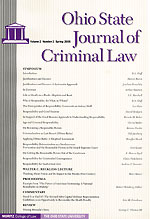
Some comments to the prior post direct particular criticism directed toward Judge Pryor, perhaps because he was a controversial figure when appointed to the bench by President Bush. I submit that, in this context, any assessment of Judge Pryor would be premature unless and until one has read Judge Pryor’s own recent account of his history with sentencing and his perspective on the federal sentencing system. That account appeared in the Spring 2011 issue of my own Ohio State Journal of Criminal Law as William H. Pryor Jr., Federalism and Sentencing Reform in the Post-Blakely/Booker Era, 8 Ohio St. J. Crim. L. 515 (2011).
I recommend that all sentencing fans read the entire OSJCL article by Judge Pryor. These passages from the article’s introduction should help explain the question in the title of this post (and perhaps also help account for why I hope all new nominees to the USSC get confirmed and get started ASAP):
During my tenure as a state attorney general from 1997 to 2004, I considered myself a sentencing reformer. My office drafted and successfully lobbied for the legislation that created the Alabama Sentencing Commission. Before my term as attorney general ended, the Commission began its long-term campaign to dismantle a regime of explosive growth in the prison population, disparities and dishonesty produced by indeterminate sentencing, and a system of corrections that offered few alternatives to incarceration as a form of punishment. Our hope was to create over time a system of voluntary sentencing guidelines to the end that criminal sentencing in Alabama could be made honest, fair, and rational.
My contributions to sentencing reform in Alabama ended in February 2004, when President George W. Bush appointed me first to serve temporarily as a circuit judge on the United States Court of Appeals for the Eleventh Circuit and later to a term of good behavior, which was confirmed by the Senate in 2005. In the meantime, the theater of sentencing changed dramatically — both for the states and the federal government — when the Supreme Court decided Blakely v. Washington in 2004 and United States v. Booker in 2005. I have had a front row seat as this play unfolded.
Although I consider myself a generalist in the performance of my public service, my experiences over the last dozen years have given me a comparative perspective of sentencing guidelines and scholarship. Over the last several years, I have participated in the adjudication of hundreds of federal appeals of criminal convictions and sentences and the collateral review of hundreds of state convictions and sentences. I have followed the successful, but often ignored, efforts of state sentencing commissions and reform movements and served as part of the members’ consultative group of the revision of the sentencing provisions of the Model Penal Code. I also have read scholarship about and discussed with colleagues the widespread dissatisfaction with the federal sentencing guidelines….
I also have a perspective of federalism, shaped by my experience as a state attorney general, federal judicial servant, and teacher of federal jurisdiction, that a structural problem underlies the current challenges to federal and state sentencing reform. This structural problem involves the federalization of crime. In the spirit of making a modest contribution to the vision of the great reformer, Judge Frankel, I submit that sentencing commissions and lawmakers should consider this structural problem and together find creative solutions to the current challenges for sentencing reform.
My hope for sentencing reform is rooted in a respect for federalism, a venerable feature of the American constitutional order. Restoring some respect for federalism in criminal law might help bridge the political divide between the left and the right, the judicial divide between formalists and pragmatists, and the sentencing divide between individual sentencing and consistency in sentencing. To restore respect for federalism, we must reverse the federalization of crime.