
Parole precogs: computerized risk assessments impacting state parole decision-making

Predicting who is likely to commit a crime in the future is no easy task, as fans of “Minority Report” know well. But states that retain discretionary parole release mechanisms to some extent require its officials to do just that. And, as this lengthy Wall Street Journal article explains, state officials are (in my view, wisely) relying more and more on computerized risk assessment instruments when making parole decisions. The WSJ piece is headlined “State Parole Boards Use Software to Decide Which Inmates to Release: Programs look at prisoners’ biographies for patterns that predict future crime,” and here are excerpts:
Driven to cut ballooning corrections costs, more states are requiring parole boards to make better decisions about which convicts to keep in prison and which to release. Increasingly, parole officials are adopting data- and evidence-based methods, many involving software programs, to calculate an inmate’s odds of recidivism.
The policy changes are leading to a quiet and surprising shift across the U.S. in how parole decisions are made. Officials accustomed to relying heavily on experience and intuition when making parole rulings now find they also must take computerized inmate assessments and personality tests into account.
In the traditional system, factors like the severity of a crime or whether an offender shows remorse weigh heavily in parole rulings, criminologists say. By contrast, automated assessments based on inmate interviews and biographical data such as age at first arrest are designed to recognize patterns that may predict future crime and make release decisions more objective, advocates of the new tools say.
In the past several years, at least 15 states including Louisiana, Kentucky, Hawaii and Ohio have implemented policies requiring corrections systems to adopt modern risk-assessment methods, according to the Pew Charitable Trusts’ Public Safety Performance Project. California is using computerized inmate assessments to make decisions about levels of supervision for individual parolees. This year, West Virginia began requiring that all felons receive risk assessments; judges receive the reports before sentencing with the option to incorporate the scores into their decisions.
Such methods can contradict the instincts of corrections officials, by classifying violent offenders as a lower recidivism risk than someone convicted of a nonviolent robbery or drug offense. Criminologists say people convicted of crimes like murder often are older when considered for release, making them less likely to reoffend. Inmates convicted of nonviolent crimes like property theft, meanwhile, tend to be younger, more impulsive and adventurous—all predictors of repeat criminality….
Wider acceptance of computerized risk assessments, along with other measures to reduce state corrections budgets, has coincided with the first declines in the national incarceration rate in more than a decade.
The number of inmates in state and federal facilities fell nearly 1% in 2011 to 1.6 million, after edging down 0.1% in the prior year. The 2011 decline came entirely from state prisons, which shed 21,600 inmates, offsetting an increase of 6,600 federal prisoners. Preliminary 2012 data shows an even larger fall in state inmates of 29,000.
Experts say one reason for the decline is that fewer parolees are returning to prison. About 12% of parolees were re-incarcerated at some point in 2011 compared with 15% in 2006, representing the fifth straight year of decline, according to Justice Department data.
Texas, by reputation a tough-on-crime state, has been consistently using risk assessment longer than many states and is boosting the number of prisoners it paroles each year. With its current system, in use since 2001, it released 37% of parole applicants in 2012 versus 28% in 2005 — some 10,000 more prisoners released in 2012.
Officials in Michigan credit computerized assessments, introduced in 2006 and adopted statewide in 2008, with helping reduce the state’s prison population by more than 15% from its peak in 2007 and with lowering the three-year recidivism rate by 10 percentage points since 2005.
Still, experts say it is difficult to measure the direct impact of risk prediction because states have also taken other steps to rein in corrections costs, such as reducing penalties for drug offenses and transferring inmates to local jails.
Michigan’s assessments withstood a legal challenge in 2011, when prosecutors sought to reverse the parole of Michelle Elias, who had served 25 years for murdering her lover’s husband. A lower court, siding with the prosecutor, ruled the parole board hadn’t placed enough weight on the “egregious nature of the crime,” court documents say. The Michigan Court of Appeals overturned the decision and upheld Ms. Elias’s release.
Yet earlier this month, the same appeals court ruled the Michigan parole board had abused its discretion by releasing a man convicted of molesting his daughter. He hadn’t received sex-offender therapy while in prison, but three assessments, including one using [the computer program] Compas, had deemed him a low risk of reoffending. The appeals court, in an unpublished decision that echoed a lower court, said that Compas could be manipulated if presented “with inadequate data or individuals who lie.”
The Compas software designer, Northpointe Inc., says the assessments are meant to improve, not replace, human intelligence. Tim Brennan, chief scientist at Northpointe, a unit of Volaris Group, said the Compas system has features that help detect lying, but data-entry mistakes or inmate deceptiveness can affect accuracy, he said. The company says that officials should override the system’s decisions at rates of 8% to 15%.
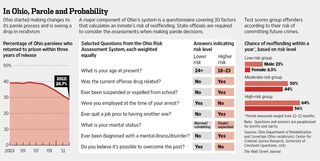
“The problem with a judge or a parole board is they can’t pull together all the information they need to make good decisions,” said Dr. Latessa, who developed an open-source software assessment system called ORAS used in Ohio and other states. Ohio adopted ORAS last year as the result of legislation aimed at addressing overcrowded prisons and containing corrections spending. Dr. Latessa does paid consulting work with state corrections agencies but isn’t paid for use of the system. “They look at one or two things,” he said. “Good assessment tools look at 50 things.”
Some assessments analyze as many as 100 factors, including whether the offender is married, the age of first arrest and whether he believes his conviction is unfair. In Texas, a rudimentary risk-assessment measures just 10 factors. Data gathered in interviews with inmates is transmitted to the offices of Texas parole board members, who vote remotely, often by computer.
Parole officials say assessment scores are just one factor they consider. Some experts say relying on statistics can result in racial bias, even though questionnaires don’t explicitly ask about race. Data such as how many times a person has been incarcerated can act as an unfair proxy for race, said Bernard Harcourt, a University of Chicago professor of law and political science. “There’s a real connection between race and prior criminal history, and a real link between prior criminal history and prediction,” Mr. Harcourt said. “The two combine in a toxic and combustive way.”
Christopher Baird, former head of the National Council on Crime and Delinquency, said statistical tools are best used to help set supervision guidelines for parolees rather than determine prison sentences or decide who should be released. “It’s very important to realize what their limitations are,” said Mr. Baird, who developed one of the earliest risk-assessment tools, for the state of Wisconsin in the late 1970s. “That’s lost when you start introducing the word ‘prediction’ and start applying that to individual cases.”