
Fascinating research on federal mortgage fraud prosecutions and sentencing in Western PA
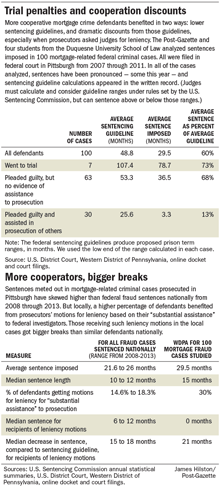
Here, from the start of the first article in the series, are the basic findings of this terrific project:
In 2008, as the housing market dragged the world economy down, orders came from Washington, D.C., to federal prosecutors nationwide: Bust the people whose lies contributed to the mess.
Six years later, the effort by Pittsburgh’s federal prosecutors to punish fraudulent mortgage brokers, appraisers, closing agents, property flippers and bank employees can claim 144 people charged, more than 100 sentenced and no acquittals.
That undefeated record, though, came at a price: Some of the worst offenders got extraordinary deals in return for their testimony against others.
A review by the Pittsburgh Post-Gazette and Duquesne University School of Law students of 100 completed cases showed that the sentences of mortgage-related criminals in the Pittsburgh area were driven more by their degree of cooperation with prosecutors than by the number of people they scammed, the dollars they reaped or the damage they did to the financial system. Some of the most prolific offenders used their central places in the fraud conspiracy to secure light sentences.
• Leniency for cooperation was doled out liberally. At least 30 of the 100 defendants were the beneficiaries of prosecutorial motions to reward “substantial assistance” to the investigation. That cooperation rate is nearly double that seen in fraud cases nationwide, suggesting that prosecutors here rewarded more defendants than normal.
• Most of the mortgage criminals who assisted prosecutors got no prison time, and the average amount of incarceration for those 30 defendants was a little more than three months. By contrast, defendants who pleaded guilty but didn’t provide substantial assistance to prosecutors, got average sentences of three years in prison. Those few who went to trial faced an average of 6½ years behind bars.
• Several of the figures most central to the region’s mortgage fraud problem cooperated with prosecutors, and got non-prison sentences. For instance, Kenneth C. Cowden, formerly of McKees Rocks and now of Florida, performed unlicensed appraisals that exaggerated real estate values in the region to the tune of hundreds of millions of dollars. He cooperated and got nine months in a halfway house. Jay Berger of Fox Chapel, who recruited Cowden and lived lavishly from fraudulent mortgages, was sentenced in 2012 to 15 months in prison, but died this month at age 49 without serving time.
Here are links to all the article in the series:
- Mortgage fraud assault a Pyrrhic victory
- Rewards uneven in mortgage fraud cases
- She fought charges, got 10-year term
- Pleading guilty could cut defendant’s sentence
Regular readers will not be at all surprised to hear me say that I view this terrific bit of investigative journalism as further proof that those who are really concerned about suspect disparities in federal sentencing ought to be much more focused on the application of (hidden and unreviewable) prosecutorial sentencing discretion than about the exercise of (open and reviewable) judicial sentencing discretion.