
Prison Policy Initiative releases new report “Youth Confinement: The Whole Pie 2025”
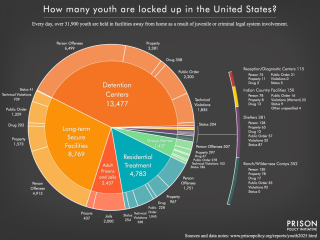
In the past 25 years, the number of youth confined in facilities away from home as a result of juvenile or criminal legal system involvement has dropped by over 70%, to about 31,900 at last count in 2023. In the criminal legal system context, this is an unparalleled rate of decarceration. But while the juvenile system’s shift from carceral punishment to more community-based responses to law- and rule-breaking behavior offers lessons for the broader criminal legal system, our analysis of the most recent data shows this work is far from complete. Tens of thousands of children and adolescents are still held under lock and key each day, most in restrictive facilities that look and feel a lot like adult prisons and jails. In fact, the U.S. still confines youth at a rate that’s more than twice the global average, and well above that of all other NATO member countries….
Generally speaking, state juvenile legal systems handle cases involving defendants under the age of 18. (This is not a hard-and-fast rule, however; every state makes exceptions for younger people to be prosecuted as adults in some situations or for certain offenses. ) Of the 29,300 youth in juvenile facilities, more than two-thirds (68%) are aged 16 or older. Troublingly, about 400 confined children are no more than 12 years old.
Gender. The vast majority (85%) of confined youth are boys, but girls make up a greater proportion of the youngest kids in the system: 45% of girls in confinement are under 16 compared to 30% of boys. Below age 13, these differences grow even starker, as nearly 1 in 10 girls in the system are younger than 13, compared to nearly 1 in 20 boys.
Race and ethnicity. Black and Indigenous youth are overrepresented in juvenile facilities, while white youth are underrepresented. These racial disparities are particularly pronounced among both Black boys and Black girls, and while Indigenous girls make up a small part of the confined population, they are extremely overrepresented relative to their share of the total youth population. While 14% of all youth under 18 in the U.S. are Black, 47% of boys and 39% of girls in juvenile facilities are Black — a level of disparity that has actually worsened in recent years. In some jurisdictions, Black children make up more than 60% of the confined youth population. And even excluding youth held in Indian country facilities, Indigenous children make up 3% of girls and 2% of boys in juvenile facilities, despite comprising less than 1% of all youth nationally.