
Might Justice Alito be a frequent vote for certain criminal defendants on the Supreme Court this term?
Conservative Justice Samuel Alito, a former U.S. attorney with a long history of voting in favor of prosecutors, has shown signs of empathy for defendants in recent cases involving gun owners, Jan 6. rioters and former President Donald Trump.
Alito, appointed in 2006 by Republican President George W. Bush, has a reputation for being the justice on the court most hostile to criminal defendants. Earlier in his career, he was a U.S. attorney in New Jersey and held several other positions in the Justice Department.
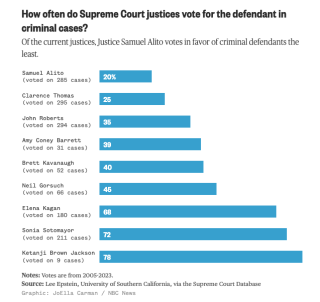
He sides with defendants less frequently than any of his eight colleagues, according to numbers crunched by Lee Epstein, a political scientist at the University of Southern California Gould School of Law.
But in several recent oral arguments in some of the most contentious cases currently before the court, Alito has notably raised questions about the Justice Department’s decisions to prosecute certain cases, expressed sympathy for Trump’s argument that former presidents should be immune from prosecution, and aired concerns about gun owners being charged. Rulings in all the cases are due by the end of June….
Alito was among several justices who questioned the Justice Department’s use of an obstruction statute to prosecute people involved in the Jan. 6, 2021, attack on the Capitol. He suggested that if the court allows it to apply to Jan. 6 defendants, prosecutors could also seek to use it against people involved in peaceful demonstrations, such as those that take place in the courtroom from time to time.
In another case on a federal ban on gun accessories called “bump stocks” that allow a semiautomatic rifle to file more quickly, Alito said it would be “disturbing” for people to be prosecuted for owning them when lower courts have questioned the ban’s lawfulness, even if the Supreme Court ultimately upholds it.
Alito also appeared concerned in a separate gun case about the due process rights of gun owners who face having to give up their firearms, and risk prosecution if they don’t, when accused of domestic violence…. At one point, he even cited a friend-of-the-court brief filed by lawyers in California who represent criminal defendants.
The fascinating (and unurprising) graph of voting patterns in criminal cases reprinted here comes the NBC News piece and is based on Epstein’s data. Though quite interesting and justifying a focus Justice Alito’s apparent affinity for certain criminal defendants this term, I also expect we will see a number of the Justices who are generally much more likley to vote for criminal defendants to be much more pro-prosecution in particular cases this term. Put simply, certain types of cases and defendants change the political valence of certain criminal justice issues, and we really should not be all that surprised when they also change the views and votes of at least some judges and Justices.