
“Count the Code: Quantifying Federalization of Criminal Statutes”
SUMMARY
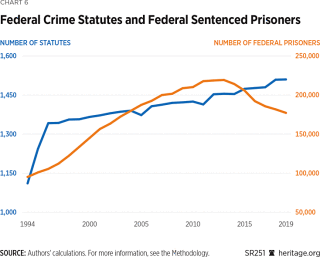
The authors have developed an algorithm to quantify the number of statutes within the U.S. Code that create one or more federal crimes. As of 2019, we found 1,510 statutes that create at least one crime. This represents an increase of nearly 36 percent relative to the 1,111 statutes that created at least one crime in 1994. Although the algorithm cannot precisely count discrete crimes within sections, we estimate the number of crimes contained within the Code as of 2019 at 5,199. These findings support the conclusion that the number of federal crimes has increased, while also bolstering concerns that federal crimes are too diffuse, too numerous, and too vague for the average citizen to know what the law requires.
KEY TAKEAWAYS
- This study quantifies the number of federal statutes that create a crime and estimates 5,199 federal crimes within the United States Code.
- From 1994 to 2019, the number of sections that create a federal crime increased 36 percent.
- Because many of these crimes apply to conduct no rational person would expect to be a crime, the government is potentially turning average Americans into criminals.
This report, and its useful but brief discussion of the “Relationship Between Federalization of Crime and Federal Prisoners” which includes the graphic reprinted above, got me to thinking about how hard it would be to effectively quantify and assess changes in federal sentencing law over the last 35 years since the passage of the Sentencing Reform Act of 1984. I was thinking about this challenge because, based on a quick read, I cannot quite tell if the algorithm used in this study picked up only federal statutes that created new crimes or also captured statutes that only changed the penalties for existing crimes (which happens fairly often).
Notably, from 1984 through 2009, most new federal sentencing laws enacted by Congress increased statutory penalties (often in complicated ways). But the 2010 Fair Sentencing Act and the 2018 FIRST STEP Act serve as recent examples lowering statutory penalties (also in complicated ways). And then, of course, starting in the late 1980s, federal law was significantly shaped by yearly federal sentencing guideline changes, some of which were directed by Congress. There have been over 800 guideline amendments, some minor (and mandatory before 2005), others major (and advisory after 2005), some even retroactive. And, thanks to Apprendi–Booker, ACCA interpretations and other jurisprudential messes, the Supreme Court and lower federal courts have been “changing” federal sentencing law in various significant ways almost continuously over this period.