
Looking at the latest data on private prison populations in the US
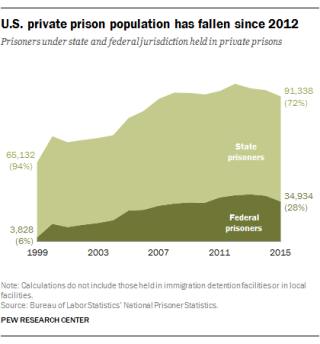
After a period of steady growth, the number of inmates held in private prisons in the United States has declined modestly in recent years and continues to represent a small share of the nation’s total prison population.
In 2015, the most recent year for which data are available, about 126,000 prisoners were held in privately operated facilities under the jurisdiction of 29 states and the federal Bureau of Prisons. That’s an 83% increase since 1999, the first year with comparable data, according to the Bureau of Justice Statistics (BJS). By comparison, the total U.S. prison population increased 12% during that span.
In more recent years, however, both the private and overall U.S. prison populations have declined at modest rates. The private prison population has shrunk by 8% since its peak in 2012, while the overall prison population has fallen by 5% since its peak in 2009. (The state private prison population peaked in 2012 with 96,774 prisoners, while the federal private prison population reached its peak a year later in 2013, with 41,159 prisoners.)…
Since 1999 — the first year BJS began collecting data on private prisons — inmates in privately run facilities have made up a small share of all U.S. prisoners. In 2015, just 8% of the nearly 1.53 million state and federal prisoners in the U.S. were in private facilities, up slightly from 5% in 1999.
State inmates make up the majority of the U.S. private prison population, as well as the overall U.S. prison population. In 2015, state prisoners made up 72% of the U.S. private prison population and 87% of the overall U.S. prison population.
In 2015, nearly three-quarters (73%) of all state prisoners in private facilities were held in the Sun Belt region of the U.S., including Texas, which has the largest private state prison population in the country. (Texas also has the second-largest state population overall.) The Lone Star State’s private prison population peaked at 20,041 in 2008, or 21% of all state inmates in privately run prisons at the time. By 2015, Texas’ private prison population had dropped to 14,293.
Florida had the second-largest private prison population (12,487) in 2015, while Georgia and Oklahoma had the third- and fourth-largest with 7,953 and 7,446, respectively. Arizona had the fifth-largest state private prison population (6,471) in 2015, a drop since the state’s peak of 8,971 in 2009.
The number and share of private prisoners under federal jurisdiction have grown since 1999. That year, 3,828 federal prisoners were being held in private prisons, comprising just 6% of the total private prison population. By 2015, the number of federal prisoners in private facilities had jumped to 34,934, accounting for 28% of the U.S. private prison population. At the same time, the share of prisoners in private facilities under state jurisdiction shrunk from 94% in 1999 to 72% in 2015.
In 2015, nearly 18% of all federal prisoners were being held in private prisons, a jump from 3% in 1999. By comparison, prisoners held in private prisons have made up less than 10% of the state prison population since 1999….
In February, Attorney General Jeff Sessions reversed a directive from the Obama administration to phase out work with private prisons at the federal level. The original Obama directive was motivated by a 2016 audit, which found that federal “contract” prisons had more safety and security incidents than comparable government-run prisons.