
Remembering that many crimes go unreported to police and that those reported often go unsolved
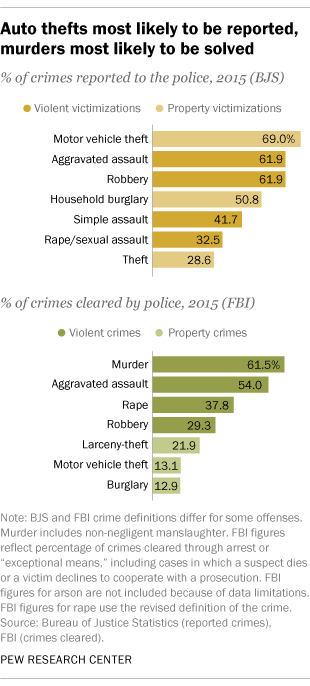
Only about half of the violent crimes and a third of the property crimes that occur in the United States each year are reported to police. And most of the crimes that are reported don’t result in the arrest, charging and prosecution of a suspect, according to government statistics.
In 2015, the most recent year for which data are available, 47% of the violent crimes and 35% of the property crimes tracked by the Bureau of Justice Statistics were reported to police. Those figures come from an annual BJS survey of 90,000 households, which asks Americans ages 12 and older whether they were victims of a crime in the past six months and, if so, whether they reported that crime to law enforcement or not.
Even when violent and property crimes are reported to police, they’re often not solved – at least based on a measure known as the clearance rate. That’s the share of cases each year that are closed, or “cleared,” through the arrest, charging and referral of a suspect for prosecution. In 2015, 46% of the violent crimes and 19% of the property crimes reported to police in the U.S. were cleared, according to FBI data.
Reporting and clearance rates for violent and property crimes have held relatively steady over the past two decades, even as overall crime rates in both categories have declined sharply. Between 1995 and 2015, the share of violent crimes reported to police each year ranged from 40% to 51%; for property crimes, the share ranged from 32% to 40%. During the same period, the share of violent crimes cleared by police ranged from 44% to 50%; for property crimes, annual clearance rates ranged from 16% to 20%.
There are several caveats to keep in mind when considering statistics like these. Like all surveys, the BJS survey has a margin of error, which means that the share of violent and property crimes reported to police might be higher or lower than estimated. The FBI clearance rate data, for their part, rely on information voluntarily reported by local law enforcement agencies around the country, and not all departments participate.
The FBI’s clearance rates also don’t account for the fact that crimes reported in one year might be cleared in a future year. In addition, they count some cases that weren’t closed through arrest, but through “exceptional means,” such as when a suspect dies or a victim declines to cooperate with a prosecution….
When it comes to deadly crimes, Chicago has drawn widespread attention recently for its historically low murder clearance rate in 2016. But murder is actually the crime that’s most likely to be solved, at least when looking at national statistics. In 2015, 62% of murders and non-negligent homicides in the U.S. were cleared. That rate hasn’t changed much since 1995, but it’s far lower than in 1965, when more than 90% of murders in the U.S. were solved.