
Examining how Michigan, thanks to Montgomery, is struggling through Miller retroactivity
Hundreds of killers sentenced to mandatory life without parole while in their teens could be resentenced this year, but a debate over how to process the cases has left prosecutors and lawyers in limbo. The Michigan Court of Appeals has been asked to decide whether a judge or jury should consider whether to give offenders new sentences. A hearing is anticipated, but a date to make arguments hasn’t been set.
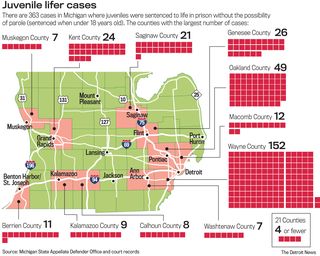
The U.S. Supreme Court ruled in 2012 that sentencing a person under 18 to life in prison without parole constitutes “cruel and unusual punishment.” The decision potentially affects 363 cases in Michigan dating to 1962.
Prosecutors have been required to provide a list to the chief judge in every county of the cases that may require resentencing. Wayne County has the most, at 152. Oakland is second with 49, followed by Genesee with 26 and Kent with 24. Macomb has 12 cases to be reconsidered for sentencing. Prosecutors will have to make legal motions to resentence those they feel still deserve life without parole. Other defendants will get a minimum of 25-40 years and a maximum of 60 years to serve before automatically being considered for parole.
Critics, including families of victims, argue mandatory resentencing may be unjust and open old wounds for victims who thought their cases were settled. Local law enforcement officials and prosecutors predict the process will be lengthy, costly and could further traumatize families.
Gov. Rick Snyder has recommended adding $1.1 million to the state budget to fund 11 full-time employees at the State Appellate Defenders Office for compliance with the Supreme Court ruling. But prosecutors, struggling with smaller staffs and tighter budgets, say they need more money too. Defense and appellate attorneys agree it’ll cost money to process the cases, but they argue it’s the right thing to do.
Many young offenders are immature, act impulsively and often are under the direction of older defendants, advocates say. Some juvenile lifers already have served beyond the minimum sentences that would have otherwise taken effect under resentencing, but for the pending hearing in the Michigan Court of Appeals.
“The bottom line is we’re not opening the doors and letting them all out — there will be a process and a hearing and some will be determined unfit for release,” said Valerie Newman, an assistant defender in the State Appellate Defenders Office. “And there will still be parole hearings.”
County prosecutors in Michigan say the process will take time, money and care to ensure that people who should be in prison stay there. St. Clair County Prosecutor Michael Wendling, who recently testified before a state Senate subcommittee on potential problems with resentencing, said: “It will tie up my staff and also challenge our resources — and I have only four cases; some counties have more than a hundred.” Wendling said after it is determined a case will be resentenced, it will mean locating victims, witnesses and experts and diverting assistant prosecutors from new cases.
Among Wendling’s old cases is one from 2010 in which Tia Skinner, then 17, plotted with a boyfriend to kill her parents after they took away her cellphone. Skinner has been resentenced twice, Wendling said. Another involves James Porter, then 17, of Yale who on one morning in 1982, balanced a .22 rifle on the handlebars of his bicycle, pedaled to the house of a friend with whom he had a dispute and fatally shot the teen and four family members. “I suspect we will be seeking the same sentences on all four of our juvenile lifers — these aren’t shoplifting cases,” Wendling said.