
Is mass incarceration contributing to the dumbing down of America?
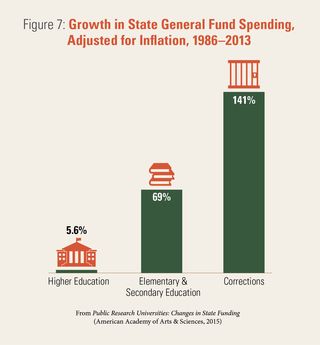
According to new data released near the end of 2015, Oregon is among the states with the lowest ratio of higher education spending to prison and incarceration spending. Criminal justice and higher education experts, advocates and reformers told GoLocal that, the state’s disparity in funding is a major issue that needs to be addressed.
According to a study entitled Public Research Universities: Changes in State Funding, published by the American Academy for Arts and Sciences, Oregon spends $204 million in higher education each year, only fifth from the bottom in the United States. Meanwhile, the state spends nearly four times that, $802 million in total, on corrections.
That gives them the second largest disparity in the country, trailing only Michigan and leading Arizona, Vermont and Colorado in the top five. According to the Academy, the lack of funding can have major impacts on the U.S. and state economy in the future….
The Partnership for Safety and Justice is also calling for a decrease in the amount of money spent on prisons. The group fights for a decrease in crime and a change in the way the criminal justice system is funded. In an interview with GoLocal, Shannon Wight, Vice President of the Partnership for Safety and Justice, said that recent actions taken by the State of Oregon to cut prison spending should be only the beginning….
Business leaders told GoLocal that more spending for schools is crucial, especially given Oregon’s issues with education. “First and foremost, we need to improve the reputation of our education system,” John Taponga, President of ECONorthwest, told GoLocal.
In order to do so, groups like the Partnership for Safety and Justice recommend taking a closer look at funding for education and incarceration. “A few years ago Pew did a similar analysis and what we learned from that is that it’s important to note is how much of our general fund we are spending on corrections vs education,” Wight said. “Certainly as a state we want to emphasize education over incarceration if we want to see the state, and its residents, thrive.”
Wight cautioned, however, that spending should be shifted gradually to avoid taking important resources away from those already serving time behind bars. “It’s important to remember that we can’t just spend less on prison and put all that money into schools right away,” Wight said. “We have to thoughtfully reduce the number of people in our correctional systems by evaluating who should be under correctional control and who shouldn’t; who should instead be receiving help from mental health or addiction services and who can be held accountable without doing prison time. Counties need the state investment to do that work effectively.”
The full report published by the American Academy for Arts and Sciences referenced in this article is available at this link. The figure reprinted here comes from the report (which also details how increased spending on health care is another key factor reshaping how states spend limited resources).