
Investigating how elected judiciary may impact capital punishment’s administration
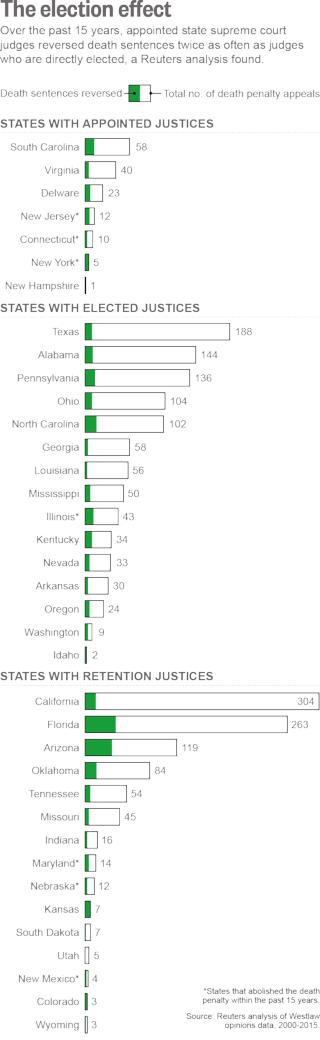
Ohio is one of the states where high court judges are directly elected – and that, a Reuters analysis found, makes a big difference in death penalty appeals.
A review of 2,102 state supreme court rulings on death penalty appeals from the 37 states that heard such cases over the past 15 years found a strong correlation between the results in those cases and the way each state chooses its justices. In the 15 states where high court judges are directly elected, justices rejected the death sentence in 11 percent of appeals, less than half the 26 percent reversal rate in the seven states where justices are appointed.
Justices who are initially appointed but then must appear on the ballot in “retention” elections fell in the middle, reversing 15 percent of death penalty decisions in those 15 states, according to opinions retrieved from online legal research service Westlaw, a unit of Thomson Reuters.
Some academic studies over the past 20 years have mirrored the Reuters analysis, showing a relationship between the result in death penalty appeals and how state supreme courts are selected. The U.S. Supreme Court has not addressed these findings in its rulings.
Now, however, at least three current justices are sympathetic to the idea that political pressure on judges is a factor that leads to arbitrary, and perhaps unconstitutional, application of the death penalty. The findings, several legal experts said, support the argument that the death penalty is arbitrary and unconstitutional because politics – in addition to the facts – influence the outcome of an appeal.
Courts have a responsibility to protect a defendant’s constitutional rights without political pressure, especially when the person’s life is at stake, said Stephen Bright, a Yale Law School lecturer who has worked on hundreds of death defenses. “It’s the difference between the rule of law and the rule of the mob,” Bright said….
State supreme courts automatically review every death penalty verdict. Apart from examining whether any legal errors were made, judges must also weigh different factors to decide whether the death sentence is an appropriate punishment. Was it the defendant’s first offense or do they have a history of violent behavior? When a death sentence is reversed, the offender usually gets life in prison instead.
But as the Reuters analysis suggests, external factors may come into play. The election effect was a far stronger variable in determining outcomes of death penalty cases than state politics and even race. Justices in states that supported Democratic President Barack Obama in the 2012 election reversed death sentences at roughly the same rate as those that went for Republican candidate Mitt Romney, at around 14 percent.
African-American defendants had lower reversal rates in both elected and appointed states. Nationally, death sentences were reversed 15 percent of the time for whites, compared with 12 percent for African-Americans, according to the Reuters findings.
Reuters did not analyze the possible impact of the race of the victim on death penalty appeals. The analysis also excluded a category of death penalty appeals known as habeas challenges, because state supreme courts are not required to hear them and overwhelmingly refuse to do so….
In 2013, Justice Sonia Sotomayor cited a study showing that Alabama judges are more likely to impose the death penalty in election years, part of a failed effort to persuade her colleagues to review an Alabama capital case.
Last June, in Glossip vs. Gross, the high court voted 5-4 that the method of execution in Oklahoma is constitutional. In dissent, Justices Stephen Breyer and Ruth Bader Ginsburg cited studies showing capital punishment is arbitrary because of racial bias, as well as political pressure, “including pressures on judges who must stand for election.”
Retired U.S. Supreme Court Justice John Paul Stevens, who has said he believes the death penalty to be unconstitutional, said in an interview that the Reuters findings “definitely lend support” to his side of the debate because they show how arbitrary capital punishment can be.