
Could marijuana reform be making Washington roadways safer even if more drivers test positive for THC?
When recreational marijuana was legalized, Washington entered the unknown, triggering questions — and predictions — about what might happen. Would drug dealers hang around the pot shops? Would it bring riffraff into the neighborhood and make shops easy crime targets? Would people abuse the drug? Or smoke and drive, putting others in harm’s way?…
The Washington Traffic Safety Commission found that marijuana has increasingly become a factor in fatal crashes. Most drivers in fatal collisions are tested for drugs. In 2014, among 619 drivers involved in fatal crashes, 89 tested positive for cannabis, according to the Washington Traffic Safety Commission. Of those marijuana-positive drivers, 75 had active THC (the psychoactive compound in cannabis) in their blood, meaning they had recently used the drug. That’s twice as many drivers with active THC in their blood than there were in 2010. About half of those 75 drivers were above the legal limit of 5 nanograms of THC per milliliter of blood, the traffic safety commission said. The driver with the highest THC level tested at 70 nanograms of marijuana per milliliter of blood — 14 times the legal limit.
Half of last year’s THC-positive drivers were also under the influence of alcohol, and most were above the 0.08 blood alcohol concentration limit, the traffic safety commission said. Marijuana and alcohol used together has a compounding effect.
Shelly Baldwin, spokeswoman for the Washington Traffic Safety Commission, said drugs have surpassed alcohol as factors in fatal crashes. “Marijuana ends up being the most frequent drug, but certainly we see methamphetamine and opiates and cocaine, prescription drugs. There’s a long list,” Baldwin said….
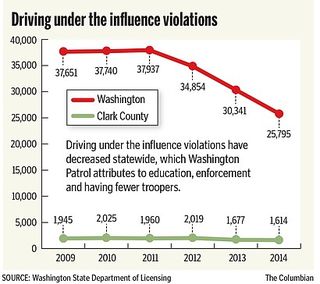
In 2014, 703 Washington drivers tested positive for being above the legal marijuana limit of 5 ng/mL. That’s a fraction of the total DUI violations, which were 25,795 statewide last year. In general, though, driving under the influence violations have gone down in Washington. That means the increase in marijuana detection among drivers is a new, unnerving trend for traffic officials….
The who, what, when, where, why and how of crime is always changing. Officials are hesitant to say what leads to crime, given its ebb and flow, making it difficult to discern whether legalizing pot affected public safety.
Marijuana-related crimes, such as possession and selling of drug paraphernalia, have dropped off, which makes sense given it’s now legal to have pot and a pipe. In general, crime has gone down around Clark County, though it increased about 1 percent for the whole state last year, according to the Washington Association of Sheriffs and Police Chiefs. Drug violations accounted for nearly 13,700 crimes reported statewide last year — an uptick from 2013’s almost 13,000 violations.
The question in the title of this post is generated by what strikes me as a remarkable — and remarkably significant? — 35% decline in the total number of DUI offenses in Washington state since marijuana was legalized by voter initiative in 2012. Many public health experts have led me to conclude that if a significant segment of the population substitutes marijuana use for alcohol use — instead of supplementing alcohol with marijuana — there will be net public-health benefits because of reduced alcohol-related harms that should surpass any increased marijuana-related harms. These data from Washington state, which do seem to show a small increase in marijuana-related roadway harms, suggest there has been a major overall reduction in dangerous driving and thus net public safety benefits in the Evergreen State since marijuana was legalized.
As I say repeatedly in a variety of settings, it is way too early to reach any firm conclusions about what basic crime and public safety data in marijuana reform jurisdictions really mean for the short- or long-term consequences of legalizations. Nevertheless, even the basic numbers reported here highlight the importance of considering all marijuana-specific data in the context of the broader public safety issues with which they interact.