
In praise of Senator Charles Grassley’s advocacy for criminal justice transparency and accountability (and his one blind spot)
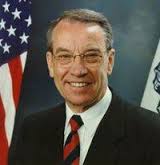
In [the Boston Bombing] high-profile case and countless others, the mechanics of our criminal justice system work day in and day out to provide equal justice under the law. Before a jury of peers, prosecutors make the government’s case on behalf of the people, and the defense works to give the accused a fair trial. America’s system of justice, including our bedrock constitutional principles guaranteeing due process, a fair and speedy trial, and the right to counsel, is a tangible right of citizenship that too often goes unnoticed. That’s because a majority of Americans aren’t able to look under the hood to see it — at least not in federal courts, which ban cameras from their courtrooms.
The federal trial in Boston carries significant public interest. And yet, the ban on cameras disallows the public to bear witness to the public proceeding. Courtroom sketches and tweets from reporters arguably don’t do justice for most people, especially those who have a keen interest to see justice served.
In this day and age when the American public is hard-wired to access what they want to see, when they want to see it, it’s hard to square the injustice of essentially banning broad civic engagement from our judicial system by banning cameras from the federal courtroom.
Blockbuster trials certainly generate a lot of attention. They renew interest in something I’ve been working to achieve for nearly two decades. And that is to unlock the federal courtroom door to cameras. As a co-equal branch of the federal government, the federal judiciary serves a fundamental function in our system of self-government. It alone interprets the constitutionality of laws passed by Congress and managed by the executive branch. Although removed from electoral politics by constitutional design, the federal judiciary and Article III judges are not part of a royal class or monarchy. The federal judiciary is the custodian of constitutional rights and providing equal justice under the law. If anything, the federal judiciary ought to be the first to throw open the shutters to bring this extraordinary branch of government to life for ordinary Americans.
As a longtime crusader for more transparency, I’ve worked to spread sunshine through the halls of the federal government. Transparency, and the accountability that comes with it, renews credibility in our institutions of government and strengthens our free and open society. The same goes for civic engagement. Allowing courtroom proceedings to be broadcast would give more citizens an opportunity to develop a better appreciation for the federal judiciary and how the wheels of justice serve the public good.
With very few exceptions, the public’s business ought to be public. Period. My leadership on this issue has prompted a few steps in the right direction, such as the adoption of pilot programs to allow cameras into some federal courts. The most recent program was launched in 2011 and includes 14 federal trial courts. So far, the sky has not fallen and the program will wrap up this summer. The courts will report back to Congress next year.
Each of the 50 states allows some level of camera access in their courtrooms. As far as I know, the recording and broadcasting of state trials haven’t turned the carriage of justice into a pumpkin. To me, it’s a miscarriage of justice that the 20th century courtroom camera ban still exists in the 21st century at the federal level….
[M]y bipartisan bill would allow the presiding judge discretion to protect the privacy of witnesses and private conversations among clients, lawyers and the judge. It prohibits the televising of jurors and includes measures to protect due process rights. The bipartisan verdict on this issue exceeds reasonable doubt. Allowing cameras into the federal courtroom would foster better civic engagement with our courts of law and, ultimately, strengthen the court of public opinion about the integrity of our judicial system in American society.
The burden of proof is clear. It’s time to lift this arbitrary barrier to transparency. Let’s end the camera ban and raise the bar on good government.
I could not agree more strongly with this forceful assertion by Senator Grassley: “With very few exceptions, the public’s business ought to be public. Period.” Now I just wish Senator Grassley would come to understand that his righteous commitment to transparency and accountability in the federal criminal justice system is deeply undermined by his steadfast support for federal mandatory minimum sentencing statutes and the extraordinary hidden power they place in the hands of unelected federal prosecutors.
Existing federal mandatory minimum statutes enable federal prosecutors to make profoundly consequential sentencing decision behind closed doors without any explanation, transparency or accountability. The US Sentencing Commission and others have frequently documented the profound sentencing impact of the hidden charging and bargaining decisions made by federal prosecutors using mandatory minimum sentencing provision. It is near impossible to even know what decisions are being made by prosecutors in the use of mandatory minimum sentencing provisions, let alone to assess effectively the legitimacy of the factors employed by prosecutors in their charging and bargaining decisions, because prosecutors need never explain or justify these sentencing decisions in any way.
My general disaffinity for federal mandatory minimum sentencing statutes is deeply based in my strong belief that “the public’s business ought to be public.” Because it seems Senator Grassley is truly and deeply committed to the values of transparency and accountability in the federal criminal justice system, I hope he will at some point come to understand how his support for federal mandatory minimums problematically disserve these critical values.