
Getting a European perspective on crowded prisons
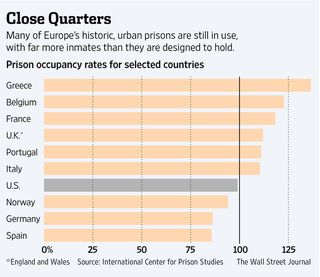
While cities and states across the U.S. are selling off prisons as the inmate population shrinks, Europe faces the opposite challenge: how to cope with chronic overcrowding in old, cramped jails.
The fortresslike structure of Forest prison is in the otherwise chic Saint-Gilles district of Brussels. Built in 1910 to house 380 inmates, it currently holds 600, most of whom are awaiting trial. In two of the four wings, three inmates are held in 90-square-foot cells designed for one. Two share bunk beds while the third has a mattress on the floor. They eat there and share a toilet. In the other half, prisoners have individual cells but no running water. They must relieve themselves in a bucket that can go unemptied for 48 hours….
“It is medieval,” said Vincent Spronck, who became warden four years ago after a decade working in other prisons. “I didn’t know these conditions still existed until I got here.” The problem isn’t limited to Forest or even Belgium.
In central London, the 170-year-old Pentonville Prison houses 1,303 men in a space designed for 913. An official report found “significant, easily visible vermin infestations,” dirty cells, and rampant drug abuse, and suggested shutting it down.
La Modelo in Barcelona, built in 1904, held 1,781 inmates in space designed for 1,100 when it was last inspected by a team from the intergovernmental Council of Europe, the continent’s human-rights watchdog. Lisbon Central Prison (built 1885) has an official capacity of 886, but was holding 1,310 prisoners in May 2013. Korydallos Prison, built in the 1960s in Athens, should hold 840 people, but held 2,300 in April 2013.
“The whole structure is in a state of crisis,” said Hugh Chetwynd, head of division for the Council of Europe’s Committee for the Prevention of Torture. Overcrowding means “staff struggle to keep proper control, so they resort more to excessive force.” Prison populations per capita are growing in most European countries….
One solution is to send prisoners abroad. Belgium pays €43 million ($48 million) a year to the Netherlands to hold 600 prisoners over the border in a former military barracks in Tilburg. Belgium and Italy, which also has a long-term overcrowding problem, are building new prisons, but some experts argue this doesn’t resolve the problem. “You build big prisons…that leads to higher population rates,” said Peter Bennett, who was warden at four prisons before becoming director of the London-based ICPS. “All the research shows that sending people to prison doesn’t reduce the crime rate.”
Still, while there appears to be no strong relationship across countries between incarceration and crime rates, the crime rate in the U.K. has fallen as the prison population has risen. Peter Cuthbertson, director of the Center for Crime Prevention, said taking serial criminals off the streets cuts crime. “If you don’t do anything else,” he said, a criminal “can easily end up committing hundreds of crimes a year.” He said that longer sentences reduce recidivism rates and while overcrowding isn’t ideal, his solution is to build more prisons.