
Is nitrogen gas the best modern execution alternative to lethal injection?
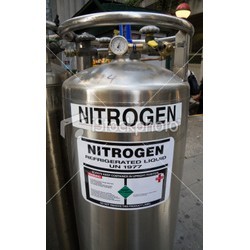
The Supreme Court ruled in 2008 that Kentucky’s three-drug protocol for carrying out lethal injections was constitutional, but there’s no question that the method looks grimly suspect in the wake of Clayton Lockett’s apparently painful, botched execution in Oklahoma last month. Not so long ago, though, this was the method that represented progress. Hanging. Firing squad. The guillotine. The electric chair. The gas chamber. Lethal injection. Every age seems to feature a new and improved method of capital punishment, billed as more efficient and humane. The spectacle of Lockett’s death, and the Supreme Court’s hesitation, shines a spotlight on the latest idea — death by nitrogen.
This new proposed method, known as nitrogen asphyxiation, seals the condemned in an airtight chamber pumped full of nitrogen gas, causing death by a lack of oxygen. Nitrogen gas has yet to be put to the test as a method of capital punishment — no country currently uses it for state-sanctioned executions. But people do die accidentally of nitrogen asphyxiation, and usually never know what hit them. (It’s even possible that death by nitrogen gas is mildly euphoric. Deep-sea divers exposed to an excess of nitrogen develop a narcosis, colorfully known as “raptures of the deep,” similar to drunkenness or nitrous oxide inhalation.)
In late April, Louisiana Department of Corrections Secretary James LeBlanc suggested to a state legislative committee that Louisiana should look into using nitrogen gas as a new method of execution, since lethal injection has become so contentious. “It’s become almost impossible to execute someone,” LeBlanc complained to the Louisiana House Administration of Criminal Justice Committee.
“Nitrogen is the big thing,” LeBlanc told the committee. “It’s a painless way to go. But more time needs to be spent [studying] that.” The committee instructed LeBlanc to do some research on the subject and report back. In the meantime, Louisiana has delayed a pending execution. “I’m not taking anything off the table,” says state Rep. Joseph P. Lopinto III, chairman of the state’s Administration of Criminal Justice Committee. “If someone says nitrogen gas is the way to go, then we can debate that and do it if need be.”
As long as 32 states have capital punishment on the books, there should be a less reliably cruel method of execution than lethal injection. “If we’re going to take a life, then we should do it in the most humane, civilized manner as is possible,” says Lawrence Gist II, an attorney and professor of business and law at Mount St. Mary’s College. “Right now, nitrogen is the best of the available options.” Gist, a death penalty opponent, runs a website dedicated to promoting nitrogen asphyxiation for state-sanctioned executions….
Nitrogen gas, unlike the lethal drugs that states have relied on, is widely available. The gas is used extensively in industrial settings, from aerospace to oil and gas production “Lethal injection is just fine if you can get the pentobarbital,” says Kent Scheidegger, legal director of the Criminal Justice Legal Foundation, a group that favors capital punishment. “But if that’s not available, an alternative like nitrogen gas would work.”
In contrast to lethal injection, no medical expertise would be needed to introduce nitrogen gas into a sealed chamber. The gas chamber itself is technology that has been around since the 1920s. In fact, three states — Arizona, Missouri, and Wyoming — still authorize lethal gas as a method of execution (depending on the choice of the inmate, the date of the execution or sentence or the possibility that lethal injection is held unconstitutional).
The last gas chamber execution in the U.S. was in 1999 — the method fell out of favor because hydrogen cyanide is a poison causing suffering that lasts 10 minutes or longer. Lethal injection, of course, was supposed to be painless and better. What if it’s not? That’s the question the Supreme Court now finally seems to be returning to. The history of capital punishment suggests that as long as there’s a will to kill criminals, someone will come up with an improved way. The new tool in the executioner’s bag may turn out to be nitrogen, a better way to carry out a gruesome task.
If nitrogen gas is really an easy, effective and painless means for killing a condemned inmate, I hope Louisiana and other states might move to this method of execution in the near future. In recent years, the only folks truly well served by lethal injection are those who enjoy last-minute appellate litigation and the prospect of a painful execution. Moreover, as I have often said before, if Congress would have the good sense to care about helping both the feds and states find a better way to carry forth capital justice, perhaps they could consider having a hearing to explore what reasonable modern alternatives to lethal injection might be worth seriously considering.
A few recent related and older posts:
- Ugly Oklahoma execution leading to calls for national moratorium
- Shouldn’t Congress be holding hearings to explore federal and state execution methods?
- Tennessee adopts electric chair as back-up execution method
- Poll after ugly execution highlights enduring death penalty support and openness to various execution methods
- A worldly perspective on different execution methods
- Should problems with lethal injection prompt return of other execution methods?