
Curious SCOTUS cert calls in criminal cases continuing, though overcriminalization now on docket
The Court on Monday granted review in two new cases; both will be decided next Term. One seeks clarification of what a home loan borrower must do in order to get out from under the mortgage because the lender allegedly failed to provide full disclosure of the loan terms (Jesinoski v. Countrywide Home Loans).
The second case raises a novel issue about how federal law treats fish as an object that cannot be destroyed because it may figure in a criminal investigation. At issue in Yates v. United States is whether the Sarbanes-Oxley Act’s ban on destroying a “tangible object” includes only materials like documents or other records, or also includes a physical object like a fish. A fisherman convicted of destroying undersized fish that he allegedly caught illegally in the Gulf of Mexico raised the question whether he had fair notice that the law applied to his action. The Court limited its grant to the first question raised in the petition.
The ongoing mystery of what the Court is doing with a California murder case — submitted to the Justices in twenty straight Conferences without word of any action — continued on Monday. The case is Ryan v. Hurles, testing when a federal habeas court must defer to a state court that did not hold an evidentiary hearing on a claim that the judge was biased. Presumably, that case will be listed again this week, for a twenty-first time. It has been put before the Justices in every scheduled Conference since September.
The Court also took no action on the latest attempt to get the Court to expand the Second Amendment right to possess a gun so that it applies outside the home. The case is Drake v. Jerejian, seeking to challenge a New Jersey law that requires an individual to obtain a permit to carry a handgun in public. The law requires proof that an individual has a “justifiable need” to carry a gun in public for purposes of self-defense….
In accepting review of the Yates case, the Court will be spelling out the scope of a law passed in the wake of the corporate scandals, particularly involving Enron Corp. A provision of that law made it a crime to interfere with a federal investigation by destroying, hiding or altering vidence. The law forbids destroying, multilating, altering, concealing or falsifying “any record, document or tangible object,” with the intent to impede or obstruct a federal investigation.
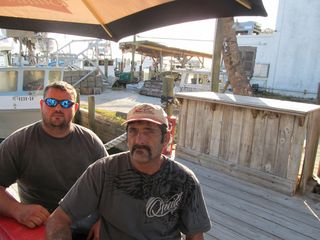
The case involves John L. Yates, a Floridian who captained a commercial fishing vessel, Miss Katie, working the waters of the Gulf of Mexico. An inspector boarded the vessel in 2000 to check for compliance with fishing regulations. While on board, he saw several red grouper fish, which appeared to him to be smaller than the 20-inch minimum size for taking that species. He measured them, and found 72 that he deemed were too small.
Yates and his crew were told to return to port, and not to disturb the catch. Yates later was charged with violating the law against destroying evidence, for allegedly ordering a crew member to throw the undersized fish overboard. The crew then replaced the discarded fish with other red grouper.
At his trial on criminal charges, including destroying evidence, Yates’ lawyers contended that the law against destroying evidence was designed only to deal with documentary evidence, and that its coverage of “tangible objects” meant to apply on to the same category. That argument failed in the trial court, and Yates was convicted of violating that provision by ordering the casting overboard of the small red grouper. The Eleventh U.S. Circuit Court of Appeals upheld his conviction, rejecting his challenge to the scope of the evidence law.
I have complained about the recent tendency of SCOTUS to take up lots of seemingly quirky criminal justice cases unlikely to have a huge impact, and then also dodging big issues like the reach and application of the Second, Sixth and Eighth Amendments in light of recent rulings. This new Yates case strikes me as another example of a seemingly quirky criminal justice case with only limited implications UNLESS some Justices were eager to make a big stink about the feds going criminally after a little fisherman.
If a majority of Justices were to develop some novel jurisprudence to help fisherman Yates prevail (and, as this local article highlights, he seems like a pretty sympathetic character), this Yates case could possibly become a very big part of on-going policy debates concerning the overfederalization and overcriminalization of seemingly small matters that arguably could and should be handled through civil means and without too much federal prosecutorial involvement. Indeed, I suspect (and certainly hope) that this Yates case might bring out more amici from the right than from the left, largely because the big concern raised by the case is the ability for small local businesses to conduct their affairs without facing criminal prosecution for not playing nice with federal bureaucrats.