
Noting disparities resulting from reservation sentencing being federal sentencing
Dana Deegan is serving a 10-year sentence for placing her newborn son in a basket and abandoning him for two weeks, allowing him to die. Deegan, who was 25 years old when her son died in 1998 on the Fort Berthold Indian Reservation, had three older children and suffered from depression and abuse. She pleaded guilty in 2007 to second-degree murder to avoid a possibly harsher sentence.
Advocates have said her sentence was much harsher than those given for similar cases prosecuted in state courts in North Dakota – a disparity that critics say applies generally because American Indians accused of major crimes on reservations are prosecuted in federal courts, which generally have stiffer penalties. The issue, which lawyers, judges and legal scholars have long discussed, will soon be the subject of a national study by the U.S. Sentencing Commission.
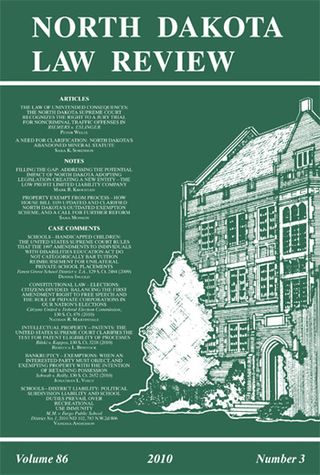
Senior Judge Myron Bright of the 8th U.S. Circuit Court of Appeals, who is based in Fargo, has for years been an outspoken critic of sentencing disparities involving prosecution of American Indians on reservations. The issue is also the focus of an article calling for changes to address the sentencing gaps in the current issue of the North Dakota Law Review [available at this link], and the study is backed by Tim Purdon, U.S. attorney for North Dakota. The law review authors, one of them a tribal judge in North Dakota, noted the Deegan case as a glaring example of the gap in sentences between the federal courts — whose defendants are overwhelmingly American Indians prosecuted on reservations — and comparable crimes tried in state courts.
Non-Indian women in two similar cases prosecuted in North Dakota state courts received much lighter sentences, authors BJ Jones and Christopher Ironroad noted [in this article, titled “Addressing Sentencing Disparities for Tribal Citizens in the Dakotas: A Tribal Sovereignty Approach”]. In 2000, a 22-year-old woman was sentenced in Cass County for negligent homicide to three years, with imposition suspended for three years of supervised probation, which was terminated less than two years later, according to court records…. In 2007, a 28-year-old woman was sentenced in Burleigh County to 10 years in prison, with eight years suspended, for causing the death of her newborn, which died after being left in a toilet….
Federal courts have jurisdiction on Indian reservations under the Major Crimes Act passed in 1885. Ordinarily, states prosecute “street crimes,” including assault, burglary, sexual assault, murder and vehicular manslaughter. Because of strict sentencing guidelines, with mandatory minimums and no probation or time off for good behavior, sentences in federal court generally are higher than those in state courts, at least in states including North Dakota, South Dakota and Montana, lawyers and federal judges agree. “The law needs to be changed and Indians need to be treated on an equal basis, the same as their white neighbors,” Bright said.
But many agree that state penalties for certain crimes, such as vehicular manslaughter, are higher. That, in fact, was a finding the last time the issue of sentencing disparities was studied in 2003 by an advisory group for the Sentencing Commission. But the group found the perception of an unfair disparity in sentences received by American Indians in federal court compared to state court was “well founded,” Purdon wrote the chairman of the Sentencing Commission earlier this month.
Purdon, who serves as chairman of the Attorney General’s Native American Issues Subcommittee, said more study is needed into the widespread perception of unfair sentences. “If the court system is perceived as unfair it undermines my ability to make the reservations safer,” he said, adding that the U.S. Department of Justice supports further study of the issue.
Two federal trial judges in North Dakota agreed that, because of federal sentencing guidelines, criminal sentences sometimes are higher than state court sentences, but cautioned that the reverse also is true for certain crimes. “I believe it works both ways,” said Chief Judge Ralph Erickson of U.S. District Court in Fargo. “Some crimes are less than customarily handed down in state courts,” such as vehicular homicide.
Much of the disparity comes from the lack of parole in the federal court system, meaning a defendant serves the entire sentence, Erickson said. “That’s where the rub comes in,” he said. “We’re aware of that and it’s frustrating.”… A comprehensive study is needed to determine if there are, in fact, sentencing disparities, Erickson said. If so, then solutions can be identified.
“There’s an overall disparity in sentencing,” said Judge Daniel Hovland of U.S. District Court in Bismarck. “Generally, federal sentences tend to be more severe,” but he agreed with Erickson that there are exceptions, including manslaughter. “I think the sentencing commission is going to take a much closer look at that issue and it will certainly bode well for everyone in the judicial system,” Hovland said. “I’m confident they’ll reach a fair assessment.”