
As fights over John Hinckley’s fate continue three decades after his violent crime, what are enduring CJ legacies or lessons?
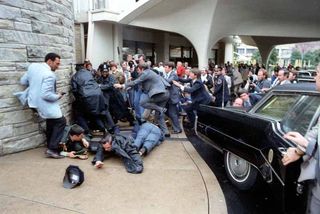
John Hinckley will almost certainly be home for the holidays, which will bring much joy to his 86-year-old mother but not to the U.S. Justice Department. No matter whether there has been a Democrat in the White House or a Republican, the Justice Department has argued against letting Hinckley out of the mental hospital where he has been incarcerated since 1982.
His family, lawyers and a number of psychiatrists and psychologists who have treated Hinckley over the years say he has responded successfully to treatment, is no longer a danger to himself and others, and that he should be allowed more and more days outside the hospital.
Hinckley had been allowed 10 days per month to visit his mother in Williamsburg, Va. He is not allowed to make visits in Washington because the president of the United States lives in Washington and the last time Hinckley came across a president, Hinckley shot him. Hinckley is also not allowed to visit his sister in Dallas, because the home of former President George W. Bush is a 10-minute walk away. Even in Williamsburg, Hinckley is trailed by Secret Service agents, and he must carry a GPS-enabled phone that tracks his whereabouts.
On average, a person convicted of a violent crime in America serves about five years in prison. Hinckley has served 31 years in St. Elizabeths Hospital, even though he was found not guilty of any crime because a jury decided he was insane at the time he shot Ronald Reagan, press secretary James Brady, D.C. police officer Thomas Delahanty and Secret Service agent Timothy McCarthy….
Last week, a federal judge extended the amount of time Hinckley can spend outside St. Elizabeths to 17 days per month. The seriousness with which Hinckley’s request for added visiting time was treated is indicative of how seriously the government still takes his case: Over a four-month period, lawyers battled for two weeks, and the judge’s decision was an incredible 106 pages long….
The hearing did provide some droll moments. In arguing that Hinckley was not fit to be outside of his mental hospital for a longer period of time, the government said one of his girlfriends at St. Elizabeths was “floridly psychotic.” To which Hinckley’s lawyer replied: “Who is he going to meet at St. Elizabeths?”
Hinckley’s case contains some valuable lessons: The insanity defense is very rarely used in America and usually fails when it is used. Hinckley succeeded, but what has it gotten him? More than three decades in a mental hospital may be better than more than three decades in prison, but unlike a prisoner serving a sentence with a maximum number of years, Hinckley, 58, can be locked up in the hospital until he dies.
Before Hinckley shot Reagan, he had been stalking Jimmy Carter. In October, 1980, Hinckley was arrested at Nashville’s Metropolitan Airport for concealing three handguns and 30 rounds of ammunition in his carry-on luggage. He paid a fine of $62.50 and was released from custody. Four days later, Hinckley, who had undergone psychiatric treatment for depression, went to Dallas, where he bought a gun and six bullets at a pawnshop for $47. Hinckley used this weapon to shoot Ronald Reagan, James Brady and the two law enforcement officers.
Today’s Brady law, which was enacted in 1993 and requires background checks for some gun purchases, is named for James Brady and might have prevented Hinckley from buying that gun. In 1988, his last full year in office, Reagan endorsed the Brady Bill, even though Reagan was not a fan of gun-control laws. His personal affection for Brady might have had something to do with it, but Reagan also said it was a good idea to see if a potential gun buyer had “a record of any crimes or mental problems, or anything of that kind.” The National Rifle Association condemned Reagan’s statement.
St. Elizabeths, built in 1855 as the Government Hospital for the Insane, once housed 8,000 patients. As the hospital crumbled from neglect, and as laws and attitudes about mentally ill people changed, the population dropped to its current 300 and a new hospital was built in 2010. St. Elizabeths no longer needs all of its vast 350 acres, where feral cats still roam, some of which are cared for by Hinckley, who often visits PetSmart on his home visits right after he goes to Wendy’s. About 176 acres of the property will be used for the new $3.4 billion headquarters complex of the Department of Homeland Security.
As most criminal law professors know, one of the legal legacies of Hinckley’s case was a significant retrenchment of insanity doctrines in many states. But as Hinckley’s own case may highlight, perhaps that it is ultimately a blessing and not a curse even for mentally unstable criminal defendants. And, as most gun control advocates know, Hickley’s crime created a uniquely potent person and symbol in support of gun control laws. But as recent high-profile deadly shootings highlight, there is reason to perhaps fear that the US is unable or unwilling to pursue gun control laws that would be likely able to prevent mentally unstable persons from having access to firearms.